Any of you that follow my other blog, BuildBetterSleep.com, knows that I'm a bit obsessed. I wrote a fairly extensive review of the Zeo Sleep Management System a couple of months ago, but have not been using it regularly for the last month or two. I want to wait until there's a significant change in my sleep patters (through the Paleo Diet thing?) before I measure it again. The results were basically the same from night to night.
Regardless, I found it interesting that Anderson Cooper (of CNN fame) recently reviewed the Zeo on his primetime "Anderson Live" show. The man with him evaluating his sleep pattern is Dr. Michael Brues - The Sleep Doctor. Have a look:
Wednesday, March 28, 2012
Monday, March 26, 2012
New and Improved Doug 3.2 - Now Statin Free
 |
| Photo Credit: JD Hancock via Compfight |
Once, in 2004, I had gone on a statin (Lipidil) as kind of an experiment - to see how it would improve my blood lipid profile.
It lowered my Total Cholesterol (TC) a bit, lowered the LDL a bit, and raised the HDL by a small amount. Since raising HDL as much as I could was my objective, I dropped the statin.
Then, in May of 2006, after complaining about some unusual (but not severe) pain while vigorously exercising, I had an angiogram that spotted a nasty piece of plaque on one of the major arteries of the heart. Because of the location, angioplasty was considered too risky, so I had open heart surgery to bypass the plaque in July of 2006.
After the diagnosis in May, I was put onto a series of statins (Zocor, Crestor, Lipidil), and I've been on them until today.
After a doctor visit this morning though, he and I have decided to experiment with this (it's now day 45 of no grains, no legumes and very limited dairy). Since I have blood-work on a spreadsheet back 15 years, we'll take a new baseline asap, and another one in 90 days. The statin is dropped as of today.
What I'm hoping to see are three things:
- My general blood profile will change - hopefully for the better. TC may go up, and LDL may go up as well, but the much more important HDL will raise, and Triglycerides will remain low. Apparently getting LDL Particle Size (a very important measure) is hard to do here in BC, and isn't ordered.
- Blood glucose levels will be very low. Since there's not a lot of sugar or refined carbs in the diet, this should be a no-brainer.
- Internal inflammation marker (CRP or C-Reactive Protein) will be very low as well. See the article below for my fascination with inflammation.
This inflammation is coming from an unexpected source - the grains in our diet. We've only been consuming them in a relatively unprocessed form for maybe 10,000 years. In a processed form, for about 100. This, in the evolutionary time-scale, is very, very new. Our bodies don't know how to process it.
Take a look at this article from Dr. Dwight Lundell, a heart surgeon for the last 25 years (entire article):
"The only accepted therapy was prescribing medications to lower cholesterol and a diet that severely restricted fat intake. The latter of course we insisted would lower cholesterol and heart disease. Deviations from these recommendations were considered heresy and could quite possibly result in malpractice.
It Is Not Working!
These recommendations are no longer scientifically or morally defensible. The discovery a few years ago that inflammation in the artery wall is the real cause of heart disease is slowly leading to a paradigm shift in how heart disease and other chronic ailments will be treated.
The long-established dietary recommendations have created epidemics of obesity and diabetes, the consequences of which dwarf any historical plague in terms of mortality, human suffering and dire economic consequences.
Despite the fact that 25% of the population takes expensive statin medications and despite the fact we have reduced the fat content of our diets, more Americans will die this year of heart disease than ever before.
Statistics from the American Heart Association show that 75 million Americans currently suffer from heart disease, 20 million have diabetes and 57 million have pre-diabetes. These disorders are affecting younger and younger people in greater numbers every year.
Simply stated, without inflammation being present in the body, there is no way that cholesterol would accumulate in the wall of the blood vessel and cause heart disease and strokes. Without inflammation, cholesterol would move freely throughout the body as nature intended. It is inflammation that causes cholesterol to become trapped....
...What are the biggest culprits of chronic inflammation? Quite simply, they are the overload of simple, highly processed carbohydrates (sugar, flour and all the products made from them) and the excess consumption of omega-6 vegetable oils like soybean, corn and sunflower that are found in many processed foods.
Take a moment to visualize rubbing a stiff brush repeatedly over soft skin until it becomes quite red and nearly bleeding. you kept this up several times a day, every day for five years. If you could tolerate this painful brushing, you would have a bleeding, swollen infected area that became worse with each repeated injury. This is a good way to visualize the inflammatory process that could be going on in your body right now."So this is what it's all about.
Explanations for what has happened to me (open heart surgery in 2006, followed by a stroke in 2009 - not to mention the TIA in 2008 and the "labyrinthitis" in 2007) are incredulous. Doctors finally came to the conclusion "it's gotta be genetic". That's what they say when they really mean "I haven't got a clue".
Nope - I say the more obvious answer is what I've been eating for the last 16 years.
The next task I have, in addition to monitoring blood levels moving forward, is to see if I can dredge up some old blood-work that I must have had done prior to turning vegetarian in 1996. We'll see what I can find......
Monday, March 19, 2012
A More Rational Approach - Paleo 2.0/Archevore
It's now Day 38 on the whole Paleo Diet experiment.
I've made an appointment with my doctor for next Monday to get some bloodwork done - and this will be interesting because my Crestor prescription runs out this Saturday. I had intended to ask him about going off the statin (Crestor) for the blood tests to see how my bloodwork does without this drug in my system. I guess I won't have to ask him, I'll tell him. Crestor is supposed to have a half life of about 19 hours in the body, so if I go for 3-4 days without it, it should give me a fair representation of the trend.
In all I've read, the general consensus is that it may take 6 months of the no-sugar-no-grain diet for your bloodwork to reach some kind of new stability.
I've been warned that:
This inflammation is quite likely caused by excess carbohydrate consumption in the form of sugars and grains. It all fits with my situation.
Years of eating little/no meat, compensated with an excess consumption of "good carbs" (whole wheat everything) led to chronic inflammation in my arteries. Which led to both the bypass surgery and the stroke.
Slightly Relaxing the Diet
I've read more about this topic than I did before making the vegetarian choice sixteen years ago. And I've been sure to look for "anti-paleo" arguments along the way.
As with any diet/fad/lifestyle, there are zeolots that require you to stick to a rigid formula. I'm not a big fan of zeolots, regardless of who they are, so I happened upon Dr. Kurt Harris who has taken the Paleo idea and turned it into something achievable for most of us - he calls it Archevore or Paleo 2.0. The basic guidelines are as follows - they become less important as you go down the list, so if you can hit the top few, you're doing well:
My diet program typically looks as simple as this:
I'll update the blood numbers as I get them (in a couple of weeks).
I've made an appointment with my doctor for next Monday to get some bloodwork done - and this will be interesting because my Crestor prescription runs out this Saturday. I had intended to ask him about going off the statin (Crestor) for the blood tests to see how my bloodwork does without this drug in my system. I guess I won't have to ask him, I'll tell him. Crestor is supposed to have a half life of about 19 hours in the body, so if I go for 3-4 days without it, it should give me a fair representation of the trend.
In all I've read, the general consensus is that it may take 6 months of the no-sugar-no-grain diet for your bloodwork to reach some kind of new stability.
I've been warned that:
- Total Cholesterol will likely rise - but it's been shown not to matter unless it's a huge number
- LDL Cholesterol will likely rise - the fat in the diet will cause it to go up - but again this number is not important
- VLDL (Very Low Density LDL) will be a small number - this is the deadly stuff - the stuff that gets into your arteries and causes plaques - low is good
- Triglycerides will go down - although mine were already low
- HDL will go up - this has been the problem for me - I could never raise it about 0.9mmol/L without niacin and a statin - I plan to remain on the niacin unless there is a good reason to go off
- CRP (C-Reactive Protein) is an inflammation marker in the blood - and this number has traditionally been good as well, although the statin probably had something to do with that - it should be low
This inflammation is quite likely caused by excess carbohydrate consumption in the form of sugars and grains. It all fits with my situation.
Years of eating little/no meat, compensated with an excess consumption of "good carbs" (whole wheat everything) led to chronic inflammation in my arteries. Which led to both the bypass surgery and the stroke.
Slightly Relaxing the Diet
I've read more about this topic than I did before making the vegetarian choice sixteen years ago. And I've been sure to look for "anti-paleo" arguments along the way.
As with any diet/fad/lifestyle, there are zeolots that require you to stick to a rigid formula. I'm not a big fan of zeolots, regardless of who they are, so I happened upon Dr. Kurt Harris who has taken the Paleo idea and turned it into something achievable for most of us - he calls it Archevore or Paleo 2.0. The basic guidelines are as follows - they become less important as you go down the list, so if you can hit the top few, you're doing well:
- Get plenty of sleep and deal with any non-food addictions
- Eliminate sugar and all caloric drinks
- Eliminate gluten grains and all wheat flour
- Eliminate grain and seed-derived oils (soy, canola, etc)
- 2 or 3 meals a day is best - no snacking
- Eat whole foods from animals (grass-fed ruminants, eggs, fish, seafood)
- Get lots of vitamin D - supplement if necessary
- Eat a wide variety of vegetables and fruit - easy on the fruit
- Get regular exercise
My diet program typically looks as simple as this:
- Breakfast - smoothie with coconut milk, eggs, banana, flax seed, vanilla and berries - and a couple of cups of coffee
- Lunch - big spinach salad with tomato, cucumber, onion, soft cheese, 1/2 can of tuna, olive oil and balsamic
- Dinner - a piece of chicken/fish, sweet potato, brocolli
- Dessert - Greek yogurt with berries, 1/3 dark chocolate bar (>85%), apple, hard cheese
I'll update the blood numbers as I get them (in a couple of weeks).
Wednesday, March 14, 2012
Doug 3.2
Here's the chronology:
- Doug 1.0 - most of my life, up until I was 36 years old (1996)
- Doug 1.1 - turned vegetarian for health reasons (turned out to be negative health reasons)
- Doug 2.0 - had heart bypass surgery to bypass some plaque buildup on my LAD artery
- Doug 3.0 - suffered a stroke on October 5, 2009
- Doug 3.1 - suffered another stroke and lost my voice sometime within 10 days of Oct 5
- Doug 3.2 - investigated further and have determined that my vegetarian (grain-centric) diet was responsible for Doug 2.0 thru Doug 3.1, so Doug 3.2 is my plan to address all that
So what do you think? I'm not sure any of us was born to live 3.2 separate lives, but it appears that I was.

Monday, March 12, 2012
Three Tips on Living Longer

He's a world famous cancer doctor and researcher who's now on the promotion tour for his book. If you look for his name in pop-culture, or in just about any magazine you pick up, he's there.
I haven't read the book, as I gleaned most everything he has to say for free on the web (I read several Amazon reviews that said "don't bother - you can get all this information for free on the internet).
Whether you agree with him or believe he's just the next "health pop star", his philosophy is worth a quick look. It breaks down into three very easy-to-understand rules:
- Regularity. Be "regular" in all things that you do. Go to bed at the same time. Wake up at the same time. Eat at the same times. In his opinion, our bodies thrive on regularity. And I've researched this for many posts I've made on BuildBetterSleep.com (the regularity of sleep habits build a pattern in your brain). Although the Paleo-health movement would argue that "eat when you're hungry", and perform "intermittent fasts" is contrary to his rule, I've found that the morning-noon-dinner-snack schedule seems to be hardwired in me regardless. No matter how hard I try to only eat when I'm hungry, I'm always hungry at 7:30am, 12:30pm, 6pm and 9pm.
- Eat Real Food. This one is obvious to me. And is supported by Michael Pollan and hundreds of other researchers. There can't be anyone left out there that thinks eating processed foods is a good idea. If it comes out of a box - don't eat it. Again, the Paleo movement takes this a step further. Eat foods that our ancestors from 20,000 years ago would recognize - but with some obvious modern twists. They insist that dairy, grains, and legumes were not a part of our diet then, and have lots of reasons why they shouldn't be a part of our diet now. In my experience, this gets much easier to follow once you've lived this way for a month or more.
- Be In Charge Of Your Own Health. This is near and dear to my thinking. You're foolish if you rely on something your friend said, or what your doctor said, about your health. You are the best judge of your own health. It's incumbent on you to research your own health - don't be lazy and trust someone else to do your homework. You will know more about you than anyone could possibly find out. Think critically, and don't be swayed by popular opinion. Going with that opinion, even if it's sponsored by the government (maybe I should say especially if it's sponsored by the government), could cause you more harm than good.
If you only remembered two of these three rules, I'd have to say that Eat Real Food and Be In Charge Of Your Own Health would be the ones with the biggest payback. They're the ones I'm following...
Tuesday, March 6, 2012
How to Become an "Expert"
I had a sudden realization yesterday when I was viewing a video presentation from Chris Kesser about cholesterol, the ways we measure it, what the important numbers are, and what is relative nonsense.
I listened for a while, but soon learned that Chris was an acupuncturist and an integrated medicine practitioner. I found myself discounting what he said because of his credentials.
But then I thought - what a hypocrite! Chris is doing this because he has a passion for it. And he has earned the respect of thousands by being outspoken about what he's learned. And what he's learned is how to become an expert in a field that interests him.
So that's the paradigm we're living in today.

I now consider myself well on the way to being an expert in the insomnia and sleep deprivation field, not because I wanted to, but because I found myself thrust into this confusing world. And with absolutely no information about it - I had to go find it myself. I now feel comfortable jumping in to conversations about "benzodiazapine withdrawal" and "central sleep apnea" - terms I never knew existed before.
Similarly, I thought myself relatively knowledgeable about vegetarianism when I drove down that road seventeen years ago. Too bad that most of the information that was available to me was pseudo-science, passed off as real science, by every "expert" I found.
This time around, with the low-grain/low-dairy/low-legume diet (Paleo - but I hate that term), I find myself being much more diligent in the research - looking for contrary positions on everything I read. If the contrary position doesn't stand up, it's discarded. And often it doesn't stand up. I wish there was a contrary position in 1995.
The information available to us today can be overwhelming. And often people will say (especially about diets) that information keeps changing - what's good for us one week is bad for us the next. But that's the nature of science.
If you can look at everything through skeptical lenses (skeptical being a good term - look it up), then you begin to appreciate the process. It's only when that process is "managed", as it was in the 90's, that we get into trouble.
Good thing for us that the process can't be handled anymore, unless you get everything you know from the evening news.
Viva la informacion!
Monday, February 27, 2012
Eating 3.0 (The Paleo Diet)
I'm feeling guilty about not updating the Build Better Sleep site for the last few days, but I've got this eating business on my mind...
Going from being *95% vegetarian to a diet that includes some meat, but excludes all grains and added sugar has been, to put it mildly, difficult.
You never realize how much of what we consume every day is out of the question:
The general "rule" I'm living by for the next week and a bit (with almost three weeks behind me - and I've passed up some fantastic looking food) is to eschew grains and sugars (except sugars naturally occurring in fruits or vegetables), eliminate beans - including soy beans and tofu, and not to eat anything my grandmother wouldn't recognize as food. The results of this experiment will be to see:
I really don't like calling this whole thing a diet, as the word "diet" sounds so temporary and mostly driven by losing weight. I have lost some weight, but that's surely not the reason I'm giving this a go.
I suspect (and lots of others now believe as well - including my doctor) that the fast-burn carbohydrates from grain and sugar are the root cause of obesity, diabetes, heart disease and strokes. There's a lot of science behind this, and it's too involved to get into here. Suffice it to say that it's our amplified insulin responses to grains and sugar that cause this medical cascade of serious problems. And the cure is to stabilize a low level of insulin in your blood - just like nature intended. Ask anyone with diabetes how their insulin level responds to bread (whole wheat or regular) or sugar and see what they say.
I've been quite pleasantly surprised over the last few days how many people are interested in this "Paleo" thing. The "interested" outnumber the "you're a lunatic" about 3:1. But giving up the grains and sugar (because it's in everything) is really hard in our society if you should want to play along.
In my experience, limited as it's been, is that you really crave sugar and carbohydrates for the first week or two. All the while thinking "what can I eat?". After you get over the craving hump, you're still left with the "what can I eat" question, but answers are starting to appear all over the place. I can now go to almost any restaurant and get a good low-carb meal. And when we get home I have to overhaul the pantry and make it easier to find suitable food. It should be pretty simple.
If you've read here for a while, you'll know that this entire adventure was an accident - I stumbled across this "Paleo" idea (by the way, I hate that name. Let's call it "Eating 3.0"). While the results I'm hoping for are medical, I've read much about the whole "Eating 3.0/Paleo" lifestyle program, and I have to say that I like it - it makes sense to me:
There's a great explanation behind each of these over at Mark's Daily Apple. It's mostly about doing what we've always done (until recently). No more worrying about how much we ate, or when we last hit the gym, or how we'll get some sleep before work tomorrow.
For now, the sugar/carb cravings are mostly gone (that has to be a good thing regardless of the long-term decision I make about this), and I'm feeling pretty good. None of my clothes fit, though.
I'll update this again as I get closer to an answer as to whether this is for me, and see if it's sustainable.
* I ate some fish, and a little chicken, turkey, and red meat on special occasions. But not very much.
** I'm concerned only with HDL, small-particle LDL, and triglyceride measurements. I've discovered that the general cholesterol numbers we've been fed for years at the doctors office are mostly useless.
Going from being *95% vegetarian to a diet that includes some meat, but excludes all grains and added sugar has been, to put it mildly, difficult.
You never realize how much of what we consume every day is out of the question:
- Breakfast - toast, bagels, cereal, porridge, muffins, juice
- Lunch - sandwiches, buns, jams, spreads, processed meat and cheese
- Dinner - bread, buns, any dessert you can think of
- Snacks - chips, nachos, cheese and crackers, soft drinks
The general "rule" I'm living by for the next week and a bit (with almost three weeks behind me - and I've passed up some fantastic looking food) is to eschew grains and sugars (except sugars naturally occurring in fruits or vegetables), eliminate beans - including soy beans and tofu, and not to eat anything my grandmother wouldn't recognize as food. The results of this experiment will be to see:
- How I feel - more/less energy
- If my sleep patterns change
- If my digestion changes
- If my **blood-work changes
I really don't like calling this whole thing a diet, as the word "diet" sounds so temporary and mostly driven by losing weight. I have lost some weight, but that's surely not the reason I'm giving this a go.
I suspect (and lots of others now believe as well - including my doctor) that the fast-burn carbohydrates from grain and sugar are the root cause of obesity, diabetes, heart disease and strokes. There's a lot of science behind this, and it's too involved to get into here. Suffice it to say that it's our amplified insulin responses to grains and sugar that cause this medical cascade of serious problems. And the cure is to stabilize a low level of insulin in your blood - just like nature intended. Ask anyone with diabetes how their insulin level responds to bread (whole wheat or regular) or sugar and see what they say.
I've been quite pleasantly surprised over the last few days how many people are interested in this "Paleo" thing. The "interested" outnumber the "you're a lunatic" about 3:1. But giving up the grains and sugar (because it's in everything) is really hard in our society if you should want to play along.
In my experience, limited as it's been, is that you really crave sugar and carbohydrates for the first week or two. All the while thinking "what can I eat?". After you get over the craving hump, you're still left with the "what can I eat" question, but answers are starting to appear all over the place. I can now go to almost any restaurant and get a good low-carb meal. And when we get home I have to overhaul the pantry and make it easier to find suitable food. It should be pretty simple.
If you've read here for a while, you'll know that this entire adventure was an accident - I stumbled across this "Paleo" idea (by the way, I hate that name. Let's call it "Eating 3.0"). While the results I'm hoping for are medical, I've read much about the whole "Eating 3.0/Paleo" lifestyle program, and I have to say that I like it - it makes sense to me:
- Eat lots of plants and animals
- Move around a lot at a slow pace
- Lift heavy things
- Run really fast once in a while
- Get lots of sleep
- Play
- Get some sunlight every day
- Avoid trauma
- Avoid poisonous things
- Use your mind
There's a great explanation behind each of these over at Mark's Daily Apple. It's mostly about doing what we've always done (until recently). No more worrying about how much we ate, or when we last hit the gym, or how we'll get some sleep before work tomorrow.
For now, the sugar/carb cravings are mostly gone (that has to be a good thing regardless of the long-term decision I make about this), and I'm feeling pretty good. None of my clothes fit, though.
I'll update this again as I get closer to an answer as to whether this is for me, and see if it's sustainable.
* I ate some fish, and a little chicken, turkey, and red meat on special occasions. But not very much.
** I'm concerned only with HDL, small-particle LDL, and triglyceride measurements. I've discovered that the general cholesterol numbers we've been fed for years at the doctors office are mostly useless.
Monday, February 20, 2012
An Ethical Tangent
Kathryn and Tavis were over for dinner last night. While Kathryn remains a committed vegetarian, Travis appreciates being a carnivore for one night. We had steak that I had barbequed.

Half way through my steak, listening to Kathryn talk about the ethics of eating factory made meat, and worrying about my health, I had another realization. There's got to be a way to incorporate 90% of the healthy food choices I've discovered, and remain more-or-less a vegetarian.
I looked on-line and, sure enough, there were lots of people out there with the same concerns, albeit mostly ethical. It looks like it's possible to have a "mostly paleolithic" diet (the paleo diet is the closest I've seen that comes to the ideal) if you were a vegetarian and were willing to incorporate eggs and fish. I'm willing to do that - to tell the truth the whole beef thing doesn't do much for me taste wise anymore.
So the food choices now, to obtain the 90% benefit, are:
- PROTEIN: Eggs, fish
- OILS AND FATS: Butter, Olive Oil
- FRUITS AND VEGETABLE: Everything except starchy vegetables (potatoes), easy on high sugar fruit (Bananas, Apples)
- NUTS AND LEGUMES: Most Nuts (Almonds, Cashews), No Legumes (Peanut Butter)
- GRAINS: White Rice, Quinoa
- DAIRY: Organic/Grass Fed Butter, Full Fat Greek Yogurt
- SWEETENERS: Splenda occasionally
I'm hoping that with this change I'll feel better about my karma as well as better about my health.
Many who've learned about my new eating plan (I won't say diet, because that sounds so temporary) says "it's just like Atkins" - and much of it is. Actually, he's been redeemed quite a bit since his death. At any rate, I found this simple diagram that explains the difference between Atkins and Paleo from one of the blogs I checked out:

As you can see, Paleo incorporates most of Atkins, but doesn't allow/recommend any kind of sugar - real or fake. And it doesn't allow "low carb" processed food and grains like Atkins does - although I may just find that that's a part of my diet I don't want to give up (it's really hard when you crave Multi-Grain Cheerios at 8pm - although that's hardly low-carb). I'll read more to find out what the real health consequences of this are.
An interesting side-effect in all this is that I've lost about 7lbs in the last 10 days eating this way (leaving out the grains, the potatoes and the sugar). Not that I need to lose the weight, or even that that was some kind of benefit, but interesting nonetheless.
PS: Over the last week I've spent considerable time reading as much as I can about this, looking for contrarian positions on this whole paleo diet thing. I've yet to come up with anything that contradicts the research I found in Good Calories, Bad Calories, and Why We Get Fat. I'd recommend reading Why We Get Fat for a good overview of all the science in the first book - it's really inexpensive and you can download it onto whatever reader you use (Kindle, PC, Mac, Stone Tablet).
Sunday, February 12, 2012
I'm pissed off
When my dad had multiple heart attacks in 1995, I took a look at my pudgy self, and said that I had to do something about it.
At first, it was a foray into supplements (remember I was yellow for a while from too much Beta Carotene?).
Then I did some more study, and found from multiple sources (they almost all agreed) that the healthiest diet you could have would be high fibre, low fat, and vegetarian (or mostly vegetarian).
Over the last 15 years, my cholesterol has been monitored every year (lately, several times a year) - the problem was always identified as low-HDL. I've seen countless doctors, now including the lead for stroke research in BC, countless interns, cardiologists, heart surgeons, and others. I we ever had a party, they probably couldn't all fit in my house. Everyone I ever met thought I was doing an admirable job - they were surprised I was able to ""stick to it" for so long
Every one of them knew I was a vegetarian - and most knew I was a "high fiber, low fat" person. As Gabe Mirkin used to tell me on the radio (which I listened to for a few years) "eat whole grains, fruits, vegetables, nuts and seeds" (the nuts and seeds were added in the last few years). EVERY SINGLE professional I ever talked to about diet reiterated - low fat, high fiber, no meat.
I really thought I knew what I was doing - and nobody every suggested otherwise. After pulling through the stroke two years ago, most people said to me "the reason you survived was because you were so healthy".
Bullshit.
After what I've learned in the last few days is still held as "controversial" because it seems to me that the following groups control what we think:
What I've learned is that
The bottom line, is that exactly what was predicted has happened to me. Too many carbs. Lots of veggies, (sure, so my vitamin levels are just fine). I've just nearly died. Twice.
When you think about it, carbs are a fairly recent addition to our diet (meat, vegetables, fruits, nuts and seeds have been around forever), so their digestion is a new thing for us. Grain, especially cereal grains, are only in the last couple of hundred years. Even the potato (GI-85!) came from the New World, so it's a recent addition.
So based on this new-to-me information, I'm doing this for 30 days to see how it goes - I'll have my bloodwork redone and see where I stand. I suspect LDL and total cholesterol to rise slightly, but I expect my HDL to rise significantly. I just might lose weight too. I'm hopeful that the energy levels come back, my brain works better, and I get some sleep.
So here I go again .... another attempt to save my own life....
At first, it was a foray into supplements (remember I was yellow for a while from too much Beta Carotene?).
Then I did some more study, and found from multiple sources (they almost all agreed) that the healthiest diet you could have would be high fibre, low fat, and vegetarian (or mostly vegetarian).
Over the last 15 years, my cholesterol has been monitored every year (lately, several times a year) - the problem was always identified as low-HDL. I've seen countless doctors, now including the lead for stroke research in BC, countless interns, cardiologists, heart surgeons, and others. I we ever had a party, they probably couldn't all fit in my house. Everyone I ever met thought I was doing an admirable job - they were surprised I was able to ""stick to it" for so long
Every one of them knew I was a vegetarian - and most knew I was a "high fiber, low fat" person. As Gabe Mirkin used to tell me on the radio (which I listened to for a few years) "eat whole grains, fruits, vegetables, nuts and seeds" (the nuts and seeds were added in the last few years). EVERY SINGLE professional I ever talked to about diet reiterated - low fat, high fiber, no meat.
I really thought I knew what I was doing - and nobody every suggested otherwise. After pulling through the stroke two years ago, most people said to me "the reason you survived was because you were so healthy".
Bullshit.
After what I've learned in the last few days is still held as "controversial" because it seems to me that the following groups control what we think:
- doctors parrot what they're told - we've invested so much in the old paradigm, that we're unwilling to accept a new reality
- the science of 1984 made some "conjectures" - the science was incomplete - which were later adopted by national organizations, like governments, as gospel (and nothing changes gospel ... it's too expensive)
- big pharma sold $27B in statin drugs in 2009, and spent >$2B lobbying congress - there's a problem and they're selling a fix
- big wheat and big soy lobby governments everywhere - the government of Canada has gone so far as to take control of the wheat board
- big meat, big milk, and big eggs have these messages too - you'd actually think that the meat/egg people would see this research as a marketing opportunity.
What I've learned is that
- Carbohydrates of any kind lower HDL and increase insulin in your bloodstream (to metabolize the sugar)
- Simple carbs and complex carbs aren't really that different in the insulin response they cause - a variance that now seems quite small - look at the Glycemic Indexes of all grains/grain-based-foods
- Low HDL is becoming a standard predictor of heart disease and stroke
- Carbohydrates of any kind raise insulin levels. Pure sugar has a glycemic index (GI) of 100, whole wheat bread 48-58, regular white bread 73
- I love cereal - so I eat the very best - Raisin Bran GI 61, Oatmeal GI 58
The bottom line, is that exactly what was predicted has happened to me. Too many carbs. Lots of veggies, (sure, so my vitamin levels are just fine). I've just nearly died. Twice.
When you think about it, carbs are a fairly recent addition to our diet (meat, vegetables, fruits, nuts and seeds have been around forever), so their digestion is a new thing for us. Grain, especially cereal grains, are only in the last couple of hundred years. Even the potato (GI-85!) came from the New World, so it's a recent addition.
So based on this new-to-me information, I'm doing this for 30 days to see how it goes - I'll have my bloodwork redone and see where I stand. I suspect LDL and total cholesterol to rise slightly, but I expect my HDL to rise significantly. I just might lose weight too. I'm hopeful that the energy levels come back, my brain works better, and I get some sleep.
- lots and lots of nutritionally dense veggies
- a much smaller amount of low sugar fruit (the sugar is in the fruit) - replacing bananas and apples with strawberries and blackberries
- lots and lots of olive oil - anywhere I can put it, I will
- lots of meat from ruminants (cow, bison, lamb) - grass fed if I can get it - these animals were never meant to eat grain
- lots of nuts - almonds (raw) and cashews (raw)
- lots of eggs - this will be for breakfast on days I don't have a smoothie
- smoothies for breakfast - 1 can of coconut milk blended with lots of frozen berries and some flax seed - it actually tastes great
- no dairy at all except (maybe) butter
- healthy butter (grass fed) or ghee (clarified butter) if I can find it
- no soy or soy products (tofu)
So here I go again .... another attempt to save my own life....
Friday, February 10, 2012
The Biggest Change I'm Making in 15 Years
This will probably startle most of you. And no, I haven't found Jesus.
This week, I was looking for the algorithm for my Zeo sleep manager - it's a well kept secret and I wanted to do some additional crunching of the data, so I went searching. I was led to a website called The Bulletproof Executive, and sure enough Dave A, the "Bulletproof Executive" knew the formula because he was friends with one of the founders at Zeo.
During my time hunting down this information on his site, I couldn't help but notice that, in addition to "sleep hacking" and "brain hacking", he had a section on "body hacking". I thought this would be pretty much the same thing as I do - mostly vegetarian, lots of complex carbs.
Wrong.
It was the total opposite of what I do. He calls it a modified Paleo diet - mostly meat, lots of fat (some saturated, which I've been told is evil), lots of low-glycemic vegetables, no breads or grains. Pretty much the diet our ancestors that lived in caves ate - but a little more high tech.
I dismissed him as a nutbar right away. But I thought "what the heck" and did some research on diets that were paleolithic in nature. I looked for search terms like:
The link between heart disease and saturated fat.
The link between complex carbohydrates and heart disease.
I wasn't too interested in the Paleo diet, but it was a great jumping off point.
What I found astounded me. Since I last took a serious look at this in 1995, much has been learned:
I consider that I've been unwittingly running an experiment on myself for 15 years - and the results are self evident. What I propose to do isn't hard for me - it'll be a change like I made in 1996. I'll take the best of what I know now and combine it, and try to come up with the best fit for me, starting now:
** Please no "I told you so's" here - because both of us thought I was doing a credible thing....That's the neat thing about science - facts are stubborn things.
This week, I was looking for the algorithm for my Zeo sleep manager - it's a well kept secret and I wanted to do some additional crunching of the data, so I went searching. I was led to a website called The Bulletproof Executive, and sure enough Dave A, the "Bulletproof Executive" knew the formula because he was friends with one of the founders at Zeo.
During my time hunting down this information on his site, I couldn't help but notice that, in addition to "sleep hacking" and "brain hacking", he had a section on "body hacking". I thought this would be pretty much the same thing as I do - mostly vegetarian, lots of complex carbs.
Wrong.
It was the total opposite of what I do. He calls it a modified Paleo diet - mostly meat, lots of fat (some saturated, which I've been told is evil), lots of low-glycemic vegetables, no breads or grains. Pretty much the diet our ancestors that lived in caves ate - but a little more high tech.
I dismissed him as a nutbar right away. But I thought "what the heck" and did some research on diets that were paleolithic in nature. I looked for search terms like:
The link between heart disease and saturated fat.
The link between complex carbohydrates and heart disease.
I wasn't too interested in the Paleo diet, but it was a great jumping off point.
What I found astounded me. Since I last took a serious look at this in 1995, much has been learned:
- When you reduce the animal content of your diet, you replace those calories with carbohydrates. They should have been replaced with healthy fats (olive oil). It's very hard to be a "low carb vegetarian".
- Saturated fat isn't evil. Actually the link between saturated fat and heart disease was debunked.
- Fat isn't evil. Fat is actually quite good. And the right kind of fat is even better.
- We eat sugar. Almost anything processed with grain in it is easily converted to sugar. Even the healthy bread I eat is converted to sugar. The cereal I love is converted to sugar. Even Raisin Bran, which I thought was pretty healthy, is sugar.
- With all this sugar, your insulin goes haywire. In my case, the insulin response, combined with my naturally low HDL (the "good" component of cholesterol), makes for very bad news. Things like I've experienced - heart disease and stroke.
I consider that I've been unwittingly running an experiment on myself for 15 years - and the results are self evident. What I propose to do isn't hard for me - it'll be a change like I made in 1996. I'll take the best of what I know now and combine it, and try to come up with the best fit for me, starting now:
- Back to meat - the wilder the better - grass fed beef, buffalo, deer, wild sockeye salmon
- Eggs for breakfast - probably omelettes with lots of vegetables. No toast though.
- Vegetables that are low-glycemic - cucumber, pepper, asparagus, brocolli, cauliflower
- Fruits that are low glycemic - strawberries, blueberries, raspberries
- Oil - Extra Virgin Olive Oil
- Nuts - Cashews, Almonds
- Grains - Brown Rice sparingly, very little bread, no cereal
- Dairy - Not much - maybe cream on strawberries
** Please no "I told you so's" here - because both of us thought I was doing a credible thing....That's the neat thing about science - facts are stubborn things.
Tuesday, February 7, 2012
The Observer Effect and Zeo
Most of you know that I've been using a Zeo Sleep Management system for the last few months to try and get a handle on my sleep - or more precisely, my lack of sleep.
Normally, I can count on a reasonable night if I've had some significant exercise the preceding day - on Saturday we rode a little over 30km and that seemed to be enough to trigger a reasonable night:

The parameter that I've been most concerned about is awakenings/night, but I also know that I feel much better during the day if I've received over an hour of deep sleep - like I did Saturday night.
I also did a relatively strenuous hike on Sunday. And a long bike-ride again yesterday. Sadly, those two nights aren't nearly as good.

Now I'm beginning to think that at least part of the issue is the actual measurement itself. This is known in scientific circles as the Observer Effect. This is where the actual measurement of something effects the thing your trying to measure.
The best example I know of this is trying to determine the exact tire pressure in a tire. The very act of taking the measurement will cause some of the air to leak out of the tire - effecting the number you get.
I'm suspecting that subconsciously (and sometimes consciously) I'm worried about the Zeo score that I'll get the next morning - I hope it's good, but if I look at my watch, and it's 3:30am, and I don't think I've slept, it cannot help but affect the remaining sleep that I get.
No matter how much I tell myself that it doesn't matter, it might.
Normally, I can count on a reasonable night if I've had some significant exercise the preceding day - on Saturday we rode a little over 30km and that seemed to be enough to trigger a reasonable night:

The parameter that I've been most concerned about is awakenings/night, but I also know that I feel much better during the day if I've received over an hour of deep sleep - like I did Saturday night.
I also did a relatively strenuous hike on Sunday. And a long bike-ride again yesterday. Sadly, those two nights aren't nearly as good.
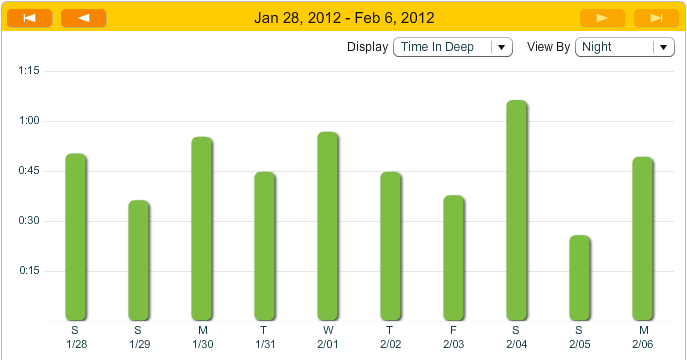
Now I'm beginning to think that at least part of the issue is the actual measurement itself. This is known in scientific circles as the Observer Effect. This is where the actual measurement of something effects the thing your trying to measure.
The best example I know of this is trying to determine the exact tire pressure in a tire. The very act of taking the measurement will cause some of the air to leak out of the tire - effecting the number you get.
I'm suspecting that subconsciously (and sometimes consciously) I'm worried about the Zeo score that I'll get the next morning - I hope it's good, but if I look at my watch, and it's 3:30am, and I don't think I've slept, it cannot help but affect the remaining sleep that I get.
No matter how much I tell myself that it doesn't matter, it might.
Sunday, February 5, 2012
Follow up to yesterday's post
I should have included this in the rant. From Wikipedia:
- Strong theist. 100 per cent probability of God. In the words of C.G. Jung: "I do not believe, I know."
- De facto theist. Very high probability but short of 100 per cent. "I don't know for certain, but I strongly believe in God and live my life on the assumption that he is there."
- Leaning towards theism. Higher than 50 per cent but not very high. "I am very uncertain, but I am inclined to believe in God."
- Completely impartial. Exactly 50 per cent. "God's existence and non-existence are exactly equiprobable."
- Leaning towards atheism. Lower than 50 per cent but not very low. "I do not know whether God exists but I'm inclined to be skeptical."
- De facto atheist. Very low probability, but short of zero. "I don't know for certain but I think God is very improbable, and I live my life on the assumption that he is not there."
- Strong atheist. "I know there is no God, with the same conviction as Jung knows there is one."
I would suggest that most people I know would call themselves a 3 to a 5. I'm a 6.95. Gotta leave a little room in case Jesus does visit the SuperBowl....
Saturday, February 4, 2012
If you're easily offended, don't read this...

If any of you know Bill Maher, he's an outspoken atheist who actually did a movie about it in 2008 - Religulous. He's not quite Richard Dawkins or Christopher Hitchens, but he's close.
Anyways, his beef this week was people who call atheism "just another religion". He and I take offence.
"Just another religion" is like that long-standing debating rebuttal "I know you are but what am I?". It involves no thinking at all. Which is the problem.
Atheism (I'd prefer to call it non-theism) isn't equivalent to religion at all.
Religion is a belief in something you can't see, and can't prove. Atheism is believing only what you can prove, and in the absence of such proof, we prefer to say "I don't know". Our opinions are subject to change as new evidence is produced.
As Bill said in his commentary, if Jesus came down from heaven during the SuperBowl and changed everyone's beer into loaves of bread and fish, he'd believe in him. So would I. but the chances of that happening are zero. Not "almost zero". Zero.
Wanna bet?
Friday, January 20, 2012
Some Sad News
Laura got home from Harrison Hotsprings today, after spending the week managing the ECE (Early Childhood Eduction) program for the Canadian Labor Congress.
She met a lady there that turned out to be friends with one of my early-days physiotherapists - Sandra. Sandra handled my physio case for the first couple of weeks in the big house, until I had a relapse and spent some extra time on the 2nd floor of Eagle Ridge Hospital.
When I came back down to the rehab wing, I was fortunate enough to have Ruth - the most senior person there, and the one with the most experience rehabilitating stroke victims. I remember her saying to me "if you stay in the wheelchair a bit longer than most, I'll get you straight from there to walking - no cane, no walker". She did what she said, and I used a cane for a total of about 10 minutes during my entire adventure.
We knew that she had gotten sick sometime shortly after I was released, but heard nothing afterwards.
Laura found out this week that Ruth died of cancer.
She met a lady there that turned out to be friends with one of my early-days physiotherapists - Sandra. Sandra handled my physio case for the first couple of weeks in the big house, until I had a relapse and spent some extra time on the 2nd floor of Eagle Ridge Hospital.
When I came back down to the rehab wing, I was fortunate enough to have Ruth - the most senior person there, and the one with the most experience rehabilitating stroke victims. I remember her saying to me "if you stay in the wheelchair a bit longer than most, I'll get you straight from there to walking - no cane, no walker". She did what she said, and I used a cane for a total of about 10 minutes during my entire adventure.
We knew that she had gotten sick sometime shortly after I was released, but heard nothing afterwards.
Laura found out this week that Ruth died of cancer.
 |
| Ruth and Me - showing me how to do stairs again |
Tuesday, January 17, 2012
Could This Be Sleep Apnea?
I've a strange phenomenon that I've noticed lately (it may have been going on for some time, but I just started paying attention to it now) - when I'm awake in the middle of the night, I'll breathe regularly and deeply 5 or 6 times, then I have no inclination/motivation to breathe for maybe another 10 seconds or so. Then the urge to breathe comes back again and the cycle repeats itself.
I have no idea if this is only a conscious thing, or whether I do it when asleep as well. If indeed I do it when asleep, I wonder if it could be the source of all the fragmented sleep?
I wrote a post early last month (December) about natural cures for sleep apnea, but I never thought at the time that I might just be talking about me! If indeed that's the problem, then I would say that it would be the rare (1%) kind - Central Sleep Apnea, not Obstructive Sleep Apnea (CSA versus OSA). I'm not overweight and I don't snore that much.
Of all the treatments I talk about in the sleep apnea post, I already do most of them. I sleep on my side, don't drink, don't take muscle relaxants, don't smoke - pretty much the only things I don't do that are common natural treatments for apnea are:
I'm not taking up the didgeridoo quite yet, so maybe I'll try sitting up. It makes sense that most of these recommendations would be for OSA, as that's the most common type, but CSA may be influenced as well. If sleeping partially sitting up doesn't do anything, I'll visit my doctor and ask him about it...
There's another unique phenomenon I've noticed recently - the use of isochronic tones to help me relax and get into a better frame of mind for sleep. I think maybe that counter intuitively they are doing more harm than good. These graphs are from my Zeo system, and they show sleep quality versus the tones:
I have no idea if this is only a conscious thing, or whether I do it when asleep as well. If indeed I do it when asleep, I wonder if it could be the source of all the fragmented sleep?
I wrote a post early last month (December) about natural cures for sleep apnea, but I never thought at the time that I might just be talking about me! If indeed that's the problem, then I would say that it would be the rare (1%) kind - Central Sleep Apnea, not Obstructive Sleep Apnea (CSA versus OSA). I'm not overweight and I don't snore that much.
Of all the treatments I talk about in the sleep apnea post, I already do most of them. I sleep on my side, don't drink, don't take muscle relaxants, don't smoke - pretty much the only things I don't do that are common natural treatments for apnea are:
- sleep partially sitting up
- play the didgeridoo
I'm not taking up the didgeridoo quite yet, so maybe I'll try sitting up. It makes sense that most of these recommendations would be for OSA, as that's the most common type, but CSA may be influenced as well. If sleeping partially sitting up doesn't do anything, I'll visit my doctor and ask him about it...
There's another unique phenomenon I've noticed recently - the use of isochronic tones to help me relax and get into a better frame of mind for sleep. I think maybe that counter intuitively they are doing more harm than good. These graphs are from my Zeo system, and they show sleep quality versus the tones:
 |
| Overall Sleep Quality (ZQ) versus Tones |
 |
| Total Sleep (Z) versus Tones |
 |
| Time in Deep Sleep versus Tones |
 |
| Time in REM Sleep versus Tones |
 |
| Times Woken versus Tones |
 |
| Time Spent Awake versus Tones |
From left to right, on all the graphs, the first bar represents no tones, the second bar insomnia-SMR tones, the third is anti-anxiety or meditation tones, and the bar on the far right represents a combination of insomnia-SMR and anxiety/meditation tones (SMR tones are sensorimotor rhythm tones at a frequency that's said to affect insomnia). There is some improvement in the number of time awakened at night by the use of anxiety/meditation tones, but it's offset by the amount of time those awakenings are...
I'm sure that looking at all these graphs drives you crazy, and you could care less, but I'd be interested to know if anyone can see anything else in them ... am I seeing things when I assume the tones do more overall harm than good?
Subscribe to:
Posts (Atom)