Monday, November 6, 2023

Introducing Doug 4.0


So since the beginning of this blog, I've changed up the title from Doug 2.0, to 3.0. to 3.1, 3.2, and now 4.0.  These have corresponded to some pretty big medical events in my life:

  • 2.0 - CABG (heart bypass surgery in 2006)
  • 3.0 - Ischemic Stroke in 2009
  • 3.1/3.2 - Stroke related events that happened during recovery
  • 4.0 - My latest diagnosis

The latest...

Late this spring, I noticed blood in my urine. After my doctor and I had eliminated a UTI as the cause, he referred me to a Urologist (Dr. Nathan Wong). Early in the summer, I had a cystoscopy which confirmed that I had bladder cancer, and then followed up by a TURBT procedure which  both cleaned up what was in the bladder, as well as determine the extent of the damage.

When the results of the TURBT biopsy came back, it was determined that I have Stage 2, Muscle Invasive Bladder Cancer. The course of treatment for this will be:

A course of chemotherapy - four rounds of two sessions each

  • Session 1 - Gemcitabine and Cisplatin 
  • Session 2 - Gemcitabine

Once the four rounds of chemotherapy are done (probably late December), I'll recover for a couple of months and then have bladder removal surgery (which will include the prostate, vas deferens, local lymph nodes, and maybe other assorted body parts). I still have to make a decision about the post-bladder direction I choose - there are a couple of options which include having a stoma with an external urine collection pouch, or the creation of an internal pouch out of intestine.

Right now, I'm leaning toward the stoma/urostomy, as it seems the simpler operation with the fewer chances for side effects. Although it does mean a radical change of life for me - I know from past experience that human beings can get used to just about anything.

So there we are. I'm right in the middle of chemo while I write this. I know it's the first time I've updated the blog in several years, but I want to log this as I go so maybe somebody will get something out of it.

PS: I've got three doctors that are working with me through this:

  • Dr. Peter La Voi - my GP here in Port Coquitlam, who was the first to jump on this and has intervened to speed things up when they started to lag.
  • Dr. Nathan Wong - my Urologist working out of New Westminster. Very focused and to the point. Reminds me of an engineer. I like that.
  • Dr. Krista Noonan - my Oncologist with BC Cancer. Very warm, knowledgeable, and works hand in hand with Dr. Wong. She's the one with the bedside manner.

I'm very happy with the team I have, and I'm most encouraged by their age - I doubt any of them is over forty.


Sunday, November 5, 2023

Citizen Chronomaster "The Citizen" AQ4030-51E


I have had over a dozen entry level luxury watches over the course of the last few years (thank you global pandemic). I had a 2000's era Omega Seamaster Pro for a long time, until a trip to Japan reignited my love of watches. That was the start of it, and it cascaded from there.

I'm sad that I let some of them go. Perhaps the hardest to come to grips with is the now "impossible to find" Grand Seiko SBGX115.

There's been a couple of others, too. When I look back at photos of my collection, I often wonder why I didn't stop then and hang on to all I had.


But on with my thought. I think I might just have the "one and done" watch in the Citizen. It's absolutely below the radar. It looks like your standard shopping mall Citizen. But it's not.


  • The watch is made of high-grade titanium with a Duratect protective treatment
  • 40mm diameter, 12.5mm thickness
  • Double domed sapphire crystal with excellent AR
  • Traditional Japanese tosa-washi paper dial - close examination shows the character of the paper
  • Citizen Eco-Drive movement, solar powered
  • Excellent visibility day or night with polished and lumed hands, dial and rehaut
  • Perpetual calendar with quick date set
  • Hacking and independent setting of hours hand
  • High Accuracy Quartz (HAQ) movement with specified accuracy of +/- 5 seconds/year. I'm getting about +/- 10 seconds/year based on my wear/use case.
  • 100m of water resistance with screw down crown
  • Titanium bracelet and clasp that is honestly the best I've ever worn
  • Screw down titanium case back
  • Zaratsu polished case - easily competes with Grand Seiko and Rolex. Actually in Japan - it does.
It's the best finished watch I've owned.
It's the most comfortable watch I've owned. 
It's the most legible watch I've owned.
It's the most accurate stand-alone watch I've owned (not syncing to some external time source).

But don't take my word for it. I first got onto this watch when I watched a video (since removed from YouTube) from jandrese. Here's his post on Reddit.

Just the other day, a popular Aussie watch vlogger (Jody at Just One More Watch) did a review. It's worth a watch.


Monday, January 27, 2020

What's new?

It's been almost two years since I wrote that last "Grand Seiko versus Rolex" post, and it's time for an update.

I still have the SBGX115 GS Quartz Diver, and it's worn regularly. So regularly in fact, that the case is getting banged up. One day, I might have to get the case refinished - but since it's a special tin plate polishing technique (in Japan, call Zaratsu) it would have to go back to Japan to be serviced. Maybe that's not such a bad thing - it's not as though I have nothing else to wear.

Grand Seiko SBGX115

We went back to Japan in the fall of 2018. I knew I had to get some kind of a souvenir watch while there, and spent a large portion of our time looking at watch shops. In the end, it was at Narita Airport on our journey home that I finally pulled the trigger and got a Seiko Presage SARX055.

The SARX055 is known as a "Baby Grand Seiko". The dial work is amazing (blow up the photo). Finished is outstanding, and the watch is in titanium (I have a thing for titanium).

SARX055

This scratched the itch for several months, but in the summer of 2019 I got the urge for something different. The watch community has a thing for Casio G-Shock. Not your run of the mill Walmart Casio G-Shock, but Japanese only boutique watches. I dipped my toe in this with a GW-5000-IJF.

Photo courtest of Seiya Japan - I buy most of my Japanese watches from him.

I had this for a short time and didn't get it. I even wrote a forum post about not getting it and got a lot of feedback (mostly negative). At any rate, when my son came home from Montreal for Christmas I gave the watch to him. And for him, it's perfect. Solar, automatic time sync, indestructible, and nerd chic.

So with that, I'm back in the hunt. My focus has drifted solidly into High Accuracy Quartz (HAQ) watches. I cannot afford any of the high-end mechanical pieces I'd be interested in (AP Royal Oak, Patek Philip Aquanaut, Vacheron Constantin Overseas, Zenith Classic Defy, Grand Seiko Snowflake).  

Audemar Piguet Royal Oak

Grand Seiko Snowflake


I'm intrigued by the high-end pieces that Citizen makes. These are models you'll never find in North America. After much consternation, I pulled the trigger on this Citizen Chronomaster:

Citizen Chronomaster CTQ57-0934

It's a very classic size - 35mm (versus 40-44 for almost everything else I have). On an alligator strap, it looks great. It's also accurate to five seconds a year, with a perpetual calendar, so there's that.

I have a five watch watchbox, so I keep six watches in rotation (one for my wrist). I have another watch on order that I'll write about next - time to remove one watch from the box. It's time for the Sumo to take a rest.

Seiko Sumo


Saturday, March 17, 2018

Grand Seiko versus Rolex

Omega Seamaster
Since I was a teenager, I've lusted for a Rolex Submariner. Always financially out of reach, I bought a "Bond" Omega Seamaster Professional 300 about fifteen years ago, and the luxury watch urge went away for a long while.

Seiko 5
The watch lust re-emerged during a trip to Japan in 2016. I was Seiko-5-curious, and wanted to pick one up to see what the fuss was about (the Seiko 5 family are low end, high quality, automatic watches). Big mistake. The low-end Seiko 5 I bought at Narita Airport in Tokyo led me to step it up a notch, and search for JDM (Japanese Domestic Market) watches from Japanese Online Watch Dealers  - who knew this was a thing?

Seiko SUMO
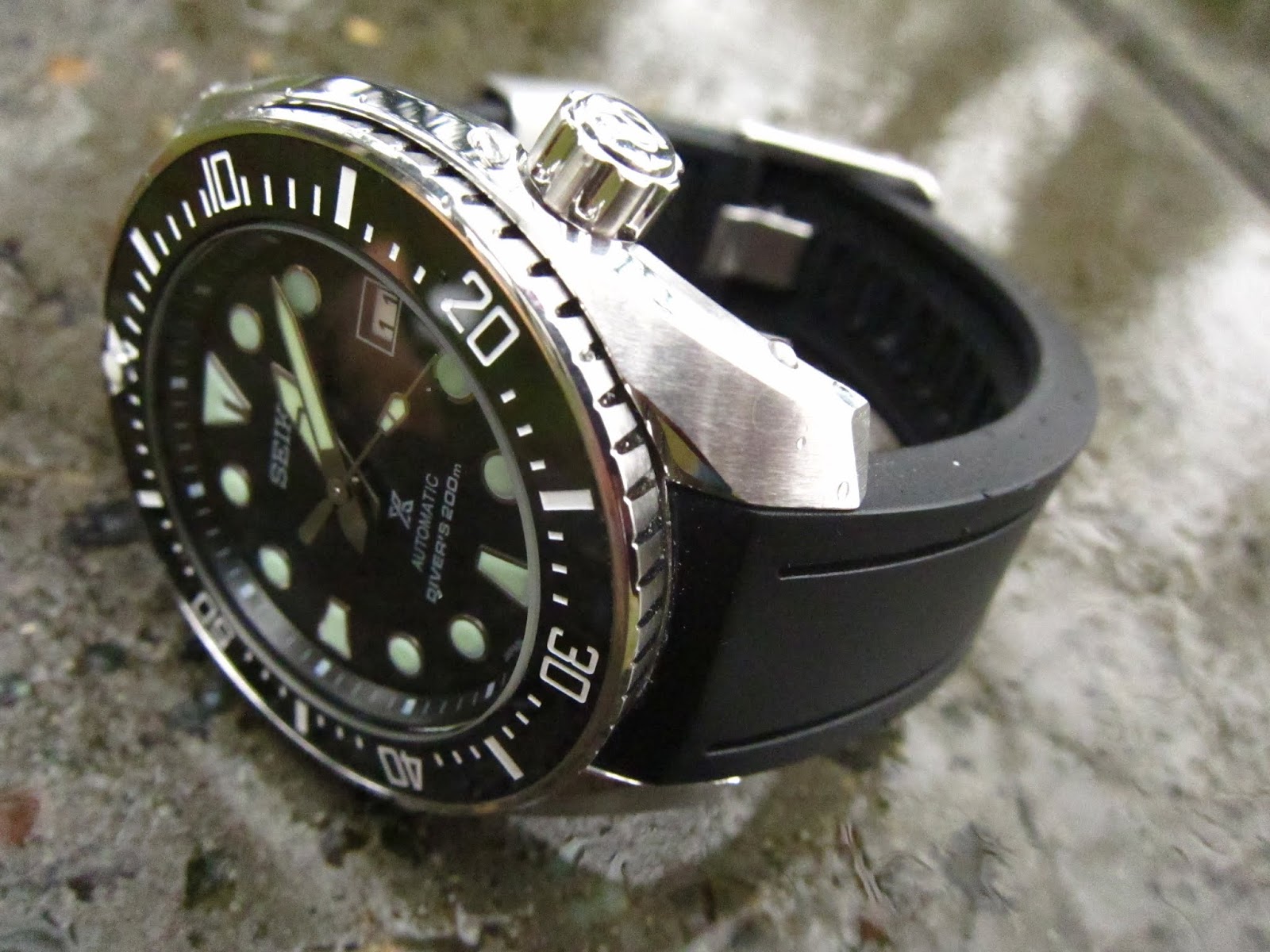
My first acquisition was a Seiko "Sumo" dive watch. I modified that watch with a ton of NATO straps, a custom rubber dive strap and a ceramic bezel insert. I also regulated the watch myself to make it more accurate than out of the box.

Next I bought a Seiko SARB dress watch - fantastic finish, same movement as the SUMO. Then a ladies dress watch for Laura. Then a vintage King Seiko. Then another Seiko 5 that I modified to be a Blancpain Fifty Fathoms homage (called a Seiko Fifty Five Fathoms - or FFF). Then a beater Seiko solar dive watch.
Seiko FFF Mod

During all this collecting, I had been searching for a specific Grand Seiko dive watch - the SBGX115/117 - that I'd seen in a YouTube video. One Sunday early this January, after a year of searching, a SBGX115 in pristine condition came up for sale in Toronto. I contacted the seller, checked his seller profile, agreed on a price, wired him the cash, and the watch was in my hands on Wednesday morning.

Vintage King Seiko
If you think of Grand Seiko to Seiko as you would Lexus to Toyota, and if you think of Rolex as the BMW of watches, then this is a Lexus versus BMW story. One Japanese, one Swiss.

Here's where the interesting Japanese versus Swiss argument begins. There seems to be two camps - and very few people who straddle both. In North America, the luxury watch business seems to be almost all Swiss. There are a handful of Japanese collectors, buy they are few and far between.

Grand Seiko SBGX115
To further separate watch collectors, there is another divide: mechanical versus quartz. Even though quartz almost killed the mechanical watch in the 70's, they were reborn as luxury jewelry, and have enjoyed great success since. The argument is that a mechanical watch (automatic is mechanical with winding done while you're wearing the piece), is elegant and precision and hand crafted (at the high end, at least), while quartz is cold and boring and machine made.

I have both types of watches. The highest end watch I now own is the Grand Seiko SBGX115,  and it's quartz. High end, high accuracy, hand made quartz - but quartz nonetheless. I do like the ruggedness and the "wear-readiness" of the SBGX115. The craftsmanship can stand up to anything
Swiss at a pricepoint within a factor of five (or ten?).

Grand Seiko Quartz Movement
I also have mechanical watches (nothing like a Rolex, but mechanical regardless). Beautiful to wear, but a pain to keep wound and the date/day properly set. The argument that mechanical involves much more engineering and artisanship than high end quartz is hollow. I'd argue that there is as much high tech involved in mechanical watch manufacturing today as there is in quartz. The hand finishing is a wash (when talking Grand Seiko anyway - it's as good or better than Swiss). And the steps people take to ensure their mechanical/automatic watches are ready to wear defeat the whole argument about artisanship anyway (I'm thinking watch winders and time graph machines and smartphone apps to set your watch with).

My SBGX115 is hand made. The quartz movement is beautiful. Servicing, for the first fifty years or so, are battery changes and gasket checks. That's it.

The equivalent dive watch - the Rolex Submariner - is more than two times the price, needs to be worn to be accurate, and needs to be serviced every ten years. A servicing is about $1000, and takes weeks (or months).

When I run my numbers, it's a wash (a nod to TGV):


-->
RolexGrand Seiko
SubmarinerSBGX115
Value59
Design109
Movement99
Brand History99
Quality9.59.5
Style108
Versatility98
Performance910
Durability9.510
X-Factor108
TOTAL9089.5

One area (not on the spreadsheet) that is definitely an advantage for Rolex steel sports watches - like the Submariner - is value retention. The Grand Seiko can't come close. So if you want to sell the watch in the future - the Rolex is the much better bet. You will likely make money on the transaction.

If you don't flip watches - the decision isn't so simple......


Sunday, October 23, 2016

PTSD and Climate Science

Last night at dinner, Kathryn and Alan talked about a phenomenon they have witnessed at recent Climate Change rallies they have attended.

The Climate Scientists (among other scientists) are scared. They are exhibiting symptoms of Post Traumatic Stress Disorder - PTSD. 

I went home to find that this phenomenon is well documented (read this). Search "climate scientist depression" and you'll find over half a million results. This is real.

Although I've been more in the camp of "do what you can not to contribute to climate change", "put a price on carbon", and "the economy will prevail to make clean energy win", these are probably nowhere near enough.

As witnessed in this round of Presidential Debates, Climate Change was barely mentioned (and not discussed) during the two hundred and seventy minutes of torture we endured.

Our own federal government has started the process to allow Liquid Natural Gas to be extracted and shipped. Next on the agenda is the pending Kinder Morgan pipeline expansion through Vancouver (Burnaby).

The net-net of Climatologist depression is that "we don't listen". Although we know that Man Made Climate Change is real, we don't take it seriously and urgently.

Taking it seriously would be:

  • Keeping oil/coal/gas in the ground.
  • No new extraction (no new pipelines).
  • Strategic financial moves to immediately get off fossil fuels. 

The argument against this is impact to individuals (employment) and the economy (taxes). Significant.

The argument for this is if we don't do it, the world will be filled with climate refugees, severe weather will become the norm (droughts, floods, fires), and wars over resources will sprout up everywhere. 

Imagine thirty million (armed) people coming across the Canadian border looking for a place to live, food to eat, and water to drink.

An excerpt from a John H. Richardson essay in Esquire in 2015:
The other topic he is obsessed with is the human suffering to come. Long before the rising waters from Greenland's glaciers displace the desperate millions, he says more than once, we will face drought-triggered agricultural failures and water-security issues—in fact, it's already happening. Think back to the 2010 Russian heat wave. Moscow halted grain exports. At the peak of the Australian drought, food prices spiked. The Arab Spring started with food protests, the self-immolation of the vegetable vendor in Tunisia. The Syrian conflict was preceded by four years of drought. Same with Darfur. The migrants are already starting to stream north across the sea—just yesterday, eight hundred of them died when their boat capsized—and the Europeans are arguing about what to do with them. "As the Pentagon says, climate change is a conflict multiplier."

Short term pain for long term gain. Mankind has never been good at this kind of choice.


Monday, October 17, 2016

Things I Know Are True

I've though about how convinced I am that things are as they seem. 

As with anything, putting it on a scale or a spectrum helps to quantify something with something else. 

So here goes:

100% - Everybody dies.
99.999% - Gravity. 
99% - My car will start tomorrow morning.
99% - There is other life in the Universe.
99% - There is no God.
95%  - Man caused global warming.
75% - Predicting the weather 2 days out.
60 %  - Jesus was a real person.
50%  - We're living in a simulation.
40% - Predicting the weather 7 days out.
1% - Donald Trump knows what he's doing
.001% - Prayer works.

What do you think?


Tuesday, May 10, 2016

All In on the Chromebook

We picked up Kathryn at the airport yesterday and she asked if I had a spare computer she could use for a few weeks - she left hers behind in London for Alan to use. I said I had my HP laptop, which has been acting up but seemed to be OK for now - it had intermittent hard drive failures but lately ran just fine.

We came home and I turned on the HP to add a user (Kathryn), but got the "blue screen of death". It kept trying to repair whatever was wrong and then rebooting. Again and again and again. So it's finally hooped.

At first I thought I would just install Linux on the laptop and be done with it. I realized, though, that i need a functioning PC to create a Linux USB Boot Disk. So that won't work.

Then I remembered an article I read last fall from Lifehacker; "How To Turn An Old Laptop Into A Chromebook". It took me about an hour of farting around, mostly because I didn't read the instructions all the way through, but it worked marvellously.

At the end of the day, I have converted my old HP 14" Envy Laptop into a very fast Chromebook. I lost all the information on the hard drive (which would have I lost anyway). I gave Kath a copy of the Chromebook environment on a USB stick so she can still run off it if the hard drive fails again.

So I guess I really am "all in" with the "Cloud". I have my phone and my Chromebook. That's it.

I've figured out ways to do most everything with the small computer - torrents, VPNs, ebooks, etc. The stuff I can't replace, I just don't use....

Because it's 2016.

Saturday, January 23, 2016

Third Time's a Charm

I migrated to Microsoft Outlook in the early days. It took me three tries to get there, though. There were all these new ideas to wrap my head around - different ways of doing things, different ways of handling events, different ways of handling email.

I went back-and-forth between the new and exciting Outlook (this must have been around 1995) and whatever I was using before  (it's lost in the dustbin of my mind so I can't even remember what it was - probably a DayTimer).

The point of this is that I would go back and forth several times before it finally stuck, and was able to move forward with the new platform. This caused me to waste all kinds of time as I would completely move over to the new system, only to move back to the old one when I discovered I couldn't do something (or thought I couldn't do something).

This time it's Inbox by Google. I was an early adopter of GMail, so I naturally started to use Google Tasks and Google Calendar as well. Integrating these on a desktop/laptop was easy, but getting them to work as one on a Smartphone never happened. The closest I got was an app that would do email (GMail), and another one that would manage tasks and calendar (CalenGoo). (The Desktop was never an issue with any platform.)

I've tried to migrate to Inbox (Google makes it pretty easy) three different times now, but kept going back to the old familiar applications.  I've also tried several stand-alone programs that handle tasks or calendar, but they didn't make life any easier.

But this time I think it's sticking. I was going to move back to the Calengoo/GMail system a couple of weeks ago, but it was now lacking some stuff I had started to rely on:

  • Reminders - which are like tasks
  • Snooze - the ability to snooze emails and reminders and have them delivered to you later
  • Pin - makes sure important emails or reminders are always there, staring you in the face

I couldn't replace any of this with the old system (without adding a bunch of new, third party programs). I even tried Microsoft Outlook for Android - which does a very nice job of integrating Email, Contacts and Calendar - but it lacks accommodation for Reminders - which is now pretty huge to me.

Google says it's going to continue investing in this platform - and they say it's the future of email. It's not perfect (the Calendar needs integration), but it's getting there. For now, I'm stuck with the new platform, and that's OK.

If you're GMail centric give it a shot - but stick with it for a couple of weeks to see if it adheres.


Sunday, January 17, 2016

It's Just Emotion That's Taken Me Over

The pseudobulbar affect, or emotional lability, affects a significant percentage of MS, ALS, traumatic brain injury, stroke, and several other survivors. You probably know someone with this affliction, and didn't really know what it was.

Emotional lability is when the person's ability to control their emotions - mostly laughing and crying - are limited or non existent. They might laugh at something that's only marginally funny or cry at something that might cause you to sigh. The outburst can often be inappropriate - laughing at something that's really sad or crying at something that's obviously funny or happy. Try as they might, those with emotional lability cannot control this.

It's not physically debilitating, but you can imagine where it can cause real trouble. If it's severe enough, it puts a damper on almost any social situation.

Which brings us to me. I have this as a result of the stroke. Initially it was completely uncontrollable and uncomfortable. As the years go by, I found it happens less and less in public, but still happens often when I'm by myself or with close family. Brother Rob often kids me about it.

For the most part when we're out in social situations it seems to be pretty repressed. There might be the odd laugh, but it doesn't come across as really awkward. When something is really funny, though, I can't contain myself. But I never could.

All the "control" I have is subconscious. There's nothing I can consciously do to try and control it (it's like you trying to control what makes you sad). And, as I said, it seems to be getting better with time .

Yesterday I had another chance to make a short speech (my story) at a Heart and Stroke Canvasser Rally. I'd done something similar this summer at a H&S Golf Tournament.

I'm completely confident before I speak, as I've done this kind of thing (speak to large groups of strangers) for most of my working life.

But when it comes time to walk up to the podium, I'm a ridiculous bundle of nerves - shaking and speaking like I'm terrified. Fortunately, Gillian (the local manager at H&S) explained what's going on after I finished talking. Everybody was very understanding.

Regardless of who you are, there are always "butterfles" in your stomach before you speak in public. They might be very small, or very big, but they're there. My best approximation of this is that I have the same thing - only amplified 10X.

I'm hoping to recover from this the same way I've recovered from the rest of my stroke. Most have diminished with repetition - months and years of repetition.

So I'm grateful for the opportunity to speak, and hope to be asked again. Speaking in this most forgiving of environments (Heart and Stroke) is wonderful - I get to continue to try, while explaining one of the awkward after affects of brain trauma.

Wednesday, November 11, 2015

The Evolution of Christianity?

This is a conundrum.

I've been exposed to a whole range of Christian belief over the years, and as a confirmed atheist (I've confirmed this myself), I've always looked on it with condescending eyes.

I went to the "Alpha Course" a few years ago, and had to quit because I found it assumed you believed the dogma before you even arrived.

There are several devout (Evangelical?) Christians in my social circle now, and I'm noticing something unnerving with their behaviour.

But let me step back for a moment.

Laura and I visited Lytton this summer to catch up with an old HP colleague and his family. We've known Steve and Yolanda (and their three daughters) since we moved back to Vancouver - so for twenty years now. The girls were babies (or unborn!) when we met them as a couple. Everybody is all grown up now, and their oldest girl has followed her mom into Counselling and Social Work.

Here's where the rubber meets the road. The entire family are Seventh Day Adventists.

This led me to a kitchen conversation with Yolanda and Stephanie about how they can set aside their personal belief system to counsel people who (very likely) share almost none of it? I also wondered why Steve and I worked so well together, and remained good friends, over our careers.

Yolanda said something very profound (I'm going to have to paraphrase).
"There are several levels to being a good Christian. Most people get stuck half way through this journey, where it's all about judgement and fear and anger and rules. They never get to unconditional acceptance and love ... that's where we try to live".

She does so well in her career (and Stephanie will too) because she accepts who you are at the outset. Never judgemental, and never putting her beliefs ahead of yours. Unconditional acceptance.

This is in sharp contrast to most other "Christians" I've met. Judge first, tell you the way the world should be, tell you how you're wrong, and tell you that they're right. We need more guns, and being gay is an abomination.

It seems to me that my Atheistic belief system is closer to Steve and Yolanda's than (fill in the blank with your favourite religion).

PS: This isn't to say that I share their belief system at all. I find it really outrageous. But we don't go there. I accept Steve and his family for who they are, and they accept me for who I am. Never prosthetizing. Never recruiting.

PPS: Very early in my days at HP, my local manager was a Mormon. Same thing. Different beliefs, but total acceptance of who I was.

Thursday, November 5, 2015

Friendship...

I was thinking about the friends that Laura and I have. Most we share because we've been together so long, and there are some peculiarities. Since I'm writing this I can only speak for me, but it's similar for Laura too...

My first best friend would have been David Sandison - back in Regina. I lived down the street from David from 1967 to 1972, and saw him a couple of times when Laura and I lived in Saskatoon (1982-1988).

Another friend in the same neighbourhood - and the same time period - was Rod Anderson. So lets call this 5 years for David and Roddy (I called him Roddy). Funny enough, Rod's parent's remain good friends of my folks (they lived next door in Regina).

We moved from Regina to Prince Rupert in 1972 and I formed a whole different set of relationships. A few of those friends have stayed in touch. But we only see each other once a year - if we're lucky. I would say Doug Lenuik and Pat Roper were my best friends in high school, and I've seen Doug a couple of times in the last 30 years (I haven't seen Pat since 1979). Let's call the Rupert years 1972-1979.

The only friend that's held up from childhood through today isn't even mine. Laura and Sherri met in high school, and I met THEM BOTH at BCIT in 1979. We see Sherri and her husband Dave a couple of times a year, but we do keep our fingers on the pulse of each other's lives.

We've retained one relationship through most of the moves - the Devall's in Calgary (Mike died in 2010, but we still see Kelly often). We met Mike and Kelly when I started with HP in 1984, and have remained good friends since (so, 31 years so far). 

The point of all this is that Laura and I have friends now that we never really knew until we moved to Vancouver as adults and parents in 1995. And we've had that same set for 20 years now. We see them all the time. 

Our closest friends, the ones who would do anything for us (and we'd do anything for them) are people we've met later in life.

Is this an artifact of people that have moved a lot? 

PS: I know I'm simplifying this a bit, as there are a few friends we met at BCIT (Al, John, Mo) that we still see pretty frequently. 

Saturday, October 24, 2015

The Election That Was

I had a visit with friends yesterday, and Lynn asked why I hadn't written something about the Canadian Election yet ... knowing that I'm passionate about politics and have never been shy about sharing my opinion.

It's been five days now, so it's time to rant a little bit.

Like almost every Canadian I know, we're fiscally conservative and socially liberal. The "Conservative Values" that were talked about during the campaign are real - and I don't have a problem with them. What I take exception to is when those values trump everything else. Name a social program in this country that hasn't been affected by budget cuts - you can't.

Balanced budgets at all cost were the demise of the Conservatives (and the NDP). I think most people understand that there is intelligent use of debt. Investment in infrastructure is good debt. Seems to me the Conservatives did just this after the financial disaster of 2008. Most examples worldwide prove that austerity doesn't work.

This election wasn't an overwhelming vote of confidence for the Liberals. It was a spanking of the Conservatives. Mostly their leader, although I took great pleasure in seeing people like Joe Oliver (former Minister of Finance), Pierre Poilevre (former Minister of Employment), and Chris Alexander (former Minister of Citizenship and Immigration), lose their seats.

Even where they won their seat, knuckle draggers like Rona Ambrose (former Minister of Health) cannot continue the damage they've done.

But the Liberals won with the same majority the Conservatives did in 2011. 39.5% of us wanted a Trudeau government, or voted strategically to get one (they didn't vote Green or NDP because they wanted Harper gone at all costs - this describes me).

In the final analysis I'm very pleased with the outcome - the Conservatives are decimated (sorry, Lynn) and are re-examining where they failed.

Trudeau has some big issues to tackle, but this whole "inexperience" thing - proffered by the Conservatives - is a red herring. I could run the country if surrounded by bright people.

The ability to be driven by fact, not by dogma, is all you need. This is where Harper failed.

Wednesday, May 20, 2015

Migrating to the Cloud - The Chromebook Experience

After mulling it about for months and months, I took the leap about a year ago and bought a Chromebook (an Acer C720 - 2GB RAM and16GB SSD - $269).

I rely less and less on native Windows applications, and found I spent most of my time in the Chrome browser anyway.

If you use your Smartphone a lot, and have migrated to online banking and online bill payment, I'd encourage you to measure the actual time you spend using PC or Mac applications versus just existing on the web.

What I Use Most


There are a handful of applications I use inside the Chrome browser (and consequently the Chromebook) most of the time. Other than normal web apps (email, calendar, banking, Twitter, Facebook) there are a few "quasi-browser" programs I use on the Chromebook:

  • Dropbox - is now a Chromebook application from the Google Play store.
  • Microsoft Office Online - works just fine and I use it with Dropbox to edit Microsoft Word documents (I could use Google Sheets as well).
  • Google Docs/Sheets - works offline as well.
  • Bittorrent Client - I'm playing with Bitford right now, but searching for another client - install from the Google Play store. 
  • Flipboard - I use this for all my newsfeeds - I don't trust Facebook to filter news for me.
  • Hootsuite - this manages multiple Twitter/Facebook/Linkedin feeds.
  • Netflix - works just fine from a Chromebook. Change your virtual country (see PrivateInternetAccess below) and stream different Netflix streams - the UK and USA are very different from Canada.
  • PrivateInternetAccess - give me a virtual presence in several countries. Highly recommended and works fine in a Chrombook.
  • Chromecast - this is a hardware/software dongle you attach to the USB port on your TV. Indispensable for anyone operating a Chromebook, as it allows you to do a number of things with your TV (like display your desktop, stream movies, project YouTube and Netflix, etc). 

I Still Can't Replace These


There are still a handful of applications I need a Windows computer for, and if you rely on a Mac, you'll have a short list as well. The Windows PC sits in the bedroom mostly unused, and I'm always searching for a "cloud" way to do things. Over the last year, as the popularity of the Chromebook increases, the list of "PC only" apps has shortened considerably.

  • HP Scanner Utility for the Envy 4500 wireless printer/scanner. Only the scanning part won't work with the Chromebook. Printing works fine, and cloud printing is pretty painless.
  • Calibre is an ebook management programs for managing my Kindle. Most people wouldn't need this, as Amazon handles all their ebooks on their site.
  • Videostream is used for streaming movies to my Chromecast/TV. I only need this when I'm really lazy - I can either cast (using Chromecast) video to the TV or use the included HDMI connector on the Chromebook. But since there's limited storage on the Chromebook (16GB), I normally store all my movies on the PC.
  • Scrivener is an ebook editing/publishing application for creating ebooks. I haven't used this program in a few years, but it's there if I ever feel the need to write another book.
  • Prezi is presentation software I sometimes use or some contract work I do. Again, I haven't used this in over a year.
Overall, I use the Chromebook about 90% of the time. I use the desktop/laptop PC about 5% of the time for "PC only" apps, and the other 5% is for times I'm too lazy to use the Chromebook.

Other Benefits


The biggest benefits (to me) with the Chromebook platform are:
  • Cost - if I break or lose this computer, it's trivial and inexpensive to replace. The one I'm using right now cost $269.
  • Battery Life - I can get a full day of use out of my Chromebook, and often forget to charge it overnight. It will recharge in a couple of hours, so I can plug it in when I go for a walk, and it's ready to go again.
  • Size and Weight - this thing is small. Not Macbook Air small, but small - 2.76 lbs.
  • Speed - as long as you're aware that the number of browser tabs you have open effects the speed, it's very fast. If anything becomes an issue, close a tab or two. I often have 5-6 tabs open at one time, and see no performance hit.
  • Ultra Portability - as long as you have an Internet connection, this thing is fantastic. If you need to do something without net access, you have to think twice (make sure your Docs and Sheets are synced, any movies you want to watch are on the internal drive, etc.).

I'm pleased with the switch. I have a friend in Victoria (Rick) who is very Microsoft-centric and wanted me to move to the Microsoft Surface platform. It looks pretty good, and the ability to run anything and everything is a bonus, but cost is a factor. If I break or lose my Chromebook, no biggie. And since everything exists in the cloud, I lose nothing.

My next computer will be another Chromebook.


Tuesday, May 12, 2015

The Rest of the World Comes Here...

Laura and I, like you I suppose, talk a fair bit about where we'll travel to next.

Some of this is tied to just getting out of the winter (that means rain here in Vancouver), and the remainder is to visit places we haven't been before. Often, though, we return to places we have been.

We go out of our way to support local businesses where we can, so why is it that we don't support our own tourist industry?

I think it's time to change that.

The rest of the world comes to British Columbia to see all the grandeur we have to offer, but we go to Phoenix or Asia or Europe or Mexico or ....

Granted, there are six months of every year where the weather doesn't cooperate with a local vacation, but from May through October things can be spectacular.

So this year, Laura and I are taking Clark (the motor home) for three weeks and doing a circle tour in our own province.

Vancouver - Bella Coola - Port Hardy - Victoria - Vancouver.

Although I've been looking forward to this for some time, Laura is now getting more than a little curious and excited about this different (for us) holiday.

I don't know what the highlight of the trip will be, but I am looking forward to seeing:

  • Alexander Mackenzie's rock (he beat Louis and Clark to the Pacific by twelve years)
  • Grizzly Bears fishing for salmon on the Atnarko and Bella Coola rivers
  • The Museum at Bella Coola
  • The day long ferry from Bella Coola to Bella Bella
  • Ocean Falls
  • Northern Vancouver Island - Port Alice, Coal Harbour


I plan to post a gallery of photos once the trip is done... stay tuned.