Monday, February 17, 2014

If There Really Is Global Warming - Then Why The Long Winter?

That's the question you're hearing from FOX News, and now represents the thinking of 23% of Americans:
"The most recent national Climate Change in the American Mind survey found that 1 in 4 Americans think that global warming is not happening, and half say they are "worried" about it."
This has mostly arisen because journalists, deniers, and politicians have selectively chosen climate data and used it as proof that the earth is cooling down, it's part of a natural cycle, or that the subject is still up for debate.

But when we look at the big picture, and factor in all the data, Man-Made Global Warming is a fact. It's no longer a point of contention among the enlightened.

From NASA

We no longer believe the world is flat - although I'm sure you could find a few out there that would defend that position. Now we should no longer give any credibility to Global Warming Deniers .

Note that I use that term Global Warming on purpose. I've learned from Hyperobjects that using Climate Change to describe Global Warming is like using "change of living conditions" instead of "Holocaust". The complete, correct term would be "Climate Change caused by Global Warming".


Thursday, February 13, 2014

Bill Nye The Science Guy is a Moron

OK - not really a moron. Just insanely dumb to engage in a debate that he cannot win.

Bill Nye engaged in said debate with Young Earth Creationist Ken Ham at his Museum on Tuesday February 4.


This would all be an interesting circus act, if it weren't for the fact that over a half million people watched this live over a webcast, and thousands more have seen the YouTube video.

Here's why I think Bill Nye is stupid to engage with Ham in this charade.

He gives Creationism an aura of credibility. He could have the same arguments with the Flat Earth Society, the Fake Moon Landing theorists, or The Earth Is The Center Of The Universe Society (if one existed).

Nye remains completely reasonable, objective, and proof-based in his arguments, but is confounded at every opportunity. When Nye talks about a tree in Sweden being older than the 6000 years than Ham claims the earth is, Ham's response is
“We didn't see those tree rings actually forming. We didn't see those layers being laid down. You’re assuming things in regard to the past that aren't necessarily true.”
 So tree rings haven't been proven to show the age of a tree. News to me. News to science.

The more credibility we give Ham and his believers, by engaging in these silly debates, the further behind the United States falls in science. Some reports say as much at 46% of the US population holds a bible-centric, creationist view of how we got here.

The rest of us just shake our heads.

Monday, February 10, 2014

My Two Year Old Smoothie

I started a new breakfast regimen two years ago - after I convinced myself that having a bowl of Multigrain Cheerios for breakfast every morning was likely killing me.

So I started experimenting with smoothies. After several variations - with eggs and yogurt and cocoa and tomatoes and other stuff - I settled on a mixture that I've grown to like very much.

My brother Rob makes a great smoothie too - tastes similar but with different ingredients. Maybe I'll get him to write it down one day.

But here's the one I've been having most mornings for the past 700 days. And I'm still not tired of it (about once a week we'll have bacon and eggs just to mix thing up).

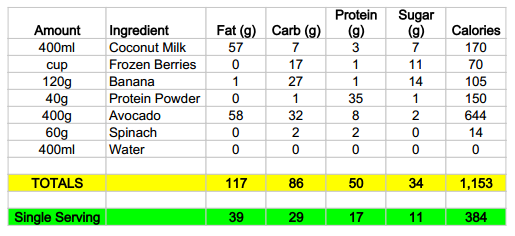
  • 1 x 400ml can Coconut Milk (Aroy-D is the brand I use - high in fat)
  • 1 cup Frozen Berries (Costco Rader Farms Nature's Three Berries)
  • 1 medium banana (120g)
  • 1 scoop (40g) Protein Powder (Kaizen Whey Isolate - Vanilla)
  • 2 small Avocados (or 1 large Avocado - about 400g)
  • 2 cups (60g) spinach
  • 1 cup water

I blend it in a Blendtec blender (like a Vitamax), but used an old Oster blender up until recently - the Blendtec makes it really smooth.

You can turn this smoothie into a red one by increasing the amount of berries (I add a half cup of blueberries) or you can make it green by adding more spinach. Any way you make it, it tastes fantastic.

And it's good for you as well. Here's the nutritional breakdown of an entire batch and for a single serving - which is about 1/3 of a batch:


It's a bit high in sugar, but all of it comes from fruit - so it's wrapped in fiber and is slow to metabolize (so no insulin spikes). High in carbs too, but it's the fruit as well. I don't care.

The fat content freaks people out, but we're all learning now that fat isn't bad for you - you need it to live. And coconut/avocado fat is excellent. I have lots in here.

A glass of this shake takes me through lunchtime easily - there is no mid-morning craving for donuts. Mind you, there is always room for another cup of coffee.....


Thursday, February 6, 2014

Eating This Stuff Is Killing Us

Obesity is the second leading contributor to premature death in North America (ref). It's complicit in heart disease, high blood pressure, diabetes, arthritis and cancer. Diet plays a huge role in obesity - along with physical activity - so I found a couple of  interesting graphics that describes how things have changed over the decades.

The first is obesity rates themselves - I'm confident that Canada would track the USA almost 1:1...

 Note that the early 1980's the US Federal Government started us all on the low-fat dogma, and has spent hundreds of millions of dollars to prove that a low fat diet is good for our health. Our fat consumption has been decreasing for decades, but our rates of obesity are skyrocketing.Clearly low fat is not good for our health.

So what's happened? Food manufacturers have gone the low fat route by substituting sugars - every kind of sugar (the most infamous being Low Fructose Corn Syrup). And when sugar isn't enough - they process the hell out of it to make it some kind of Frankenfood.

Source: Bureau of Labor Statistics. Credit: Lam Thuy Vo / NPR
When I was growing up in the 70's, processed food in the house was rare. The odd bag of potato chips, and maybe a 2l jug of Coke over Christmas.

My how things have changed.

The single biggest component of our diet is now processed foods and sugars.

Want to lose weight and get healthy? Cut out the 22.9%.

"If your grandmother wouldn't recognize it, don't eat it".


Monday, February 3, 2014

You Probably Have Enough...

"Who do you work for?"

I get that a lot. Instead of giving a roundabout, hard to explain answer, I usually just say

"I'm retired".

Then follows the automatic "you look awfully young to be retired" and then the inevitable

"I wish I could do that".

This got me thinking about the experience Laura and I have had over the last several years, and my general outlook long before then.

It's meant for people about our age (mid 50's and older) who have kids that have moved out.

And maybe it's for the younger crowd, just starting out. If they re-imagined their eventual retirement - as I'm sure most of them are doing anyway - much of this makes sense for them too.

You Have Enough

Over the last fifteen years, as I started to think about eventually quitting work, I found myself challenging the accepted belief that you needed a huge chunk of  money* to retire. It seemed however much you had, it was never going to be enough.

For me, and most people I know, the days of a defined benefit pension program were long gone. What you had accumulated needed to last until you were dead. Nobody was going to send you a regular paycheque once you stopped reporting for work.

There are entire banking sectors set up to tell you how much you'll need based on your anticipated lifestyle.

As it turned out, Laura and I were forced into this predicament by my health issues. I can't ever see a time where full-time work is a real option for me anymore. And when we look closer at it, neither of us can see a time when full-time work is required (or desired) for either of us.

So we are forced into this "early retirement" with less than we thought we needed. And I'm increasingly convinced that it is, indeed, enough.

What it needs is a change of attitude, and a real in-depth look at what's truly important to you.

What's Important

The lesson we've learned over the last eight years (2006 kicked this process off**) is that life doesn't really care how much you plan. Events will conspire to kick you in the teeth when you least expect it. The more flexible you are, the more willing you are to try new things, and the more you're able to put preconceived notions of "this is how it must be" on the back burner, the better equipped you'll be moving forward.

It's best to start with a challenge to many of the preconceptions you probably have.
  • Everyone needs to own a house. Think of all the money you have tied up in a house - money that could be working for you elsewhere. How much do you pay in property tax? Insurance? Maintenance? Self esteem? 60% of people in Germany never own a house, and never plan to. Why is that? We now rent a one bedroom basement suite.
  • Everyone needs at least two cars. Really? And how often in one of them sitting at home? What if you just managed your time better? What if both of you didn't work full time? We got rid of my truck, and we now drive Laura's much more fuel efficient car.
  • Everyone needs lots of room for their stuff. Why do you have so much stuff? If you had a fire today, and you could take just one thing before getting out of the house, what would it be? I guess I'd say "the dog".
  • We need two incomes to manage this lifestyle. So change the lifestyle. Determine what you "need" versus what you "want".

I've been anal about tracking our spending since we first got married. And I'm surprised to report that our social lifestyle hasn't really changed at all, but the cost of that lifestyle is half to one third of what it was. No more buying something because you're bored, or eating out three nights a week because you're tired.

The Strategy

Here are the steps we've taken, and so far - so good.

  • Sell your house. Hopefully, if you're in Canada at least, the house is worth more than the mortgage on it. Take the proceeds from the house and invest it wisely (be conservative - this money has to last!).
  • Sell your stuff. You're going to be moving into a much smaller place, so decide what you really need. You can't have it all - and as we've discovered - your kids likely don't want anything of yours anyway. If you need to rent some storage space, go ahead. But have some time limit to when everything in there is cleaned out.
  • Sell your car. I'd like to get rid of the cars altogether, but based on where we live, one is kind of essential. If we lived downtown, I'd likely aim for a shared-car service.
  • Pay off your debt. You should plan on having ZERO debt. Pay off credit cards every month. Have a zero balance on the line of credit. Owe nobody.
  • Move. Rent a small one or two bedroom place. What this buys you is freedom. Don't like your neighbors - move. Don't like the price of rent - move. Don't like the city - move. Much easier to be flexible as a renter than as an owner.
  • Think part time. Supplement your investment income with small, part-time jobs. We try deliberately to avoid a full time commitment (short term, full time is OK - like a maternity leave).
  • Know where you're at. Become fanatical about your financial position. Know when things are going well, and when they require some tweaking (ie: line up more work).
  • Adjust your lifestyle. Live on less. Go to movies on cheap night (around here, Tuesday). Eat at home almost all the time. Our "big night out" is on Thursday with friends, where we meet up for sushi. Costs us about $25/week. 
What these changes have afforded us is ultimate flexibility. Want to go to away for a week next month? Go. Want to go away for a month next week? Go. Want to live back in Calgary for a year? Go. Want to visit the Maritimes for a couple of months this fall. Go.

And as I mentioned earlier - our social life is better than before. And we travel three or four times as much.

We're fortunate in that I think we have enough. The number will be different for everybody, but I'm pretty certain that it's significantly less than what you think.

Our lifestyle today runs about $3500/month, with about $1000/month of this set aside for vacations. When we add up the part-time jobs we have along with the investment income, we're doing quite nicely.

The Benefits

There are a few subtle benefits that seem obvious to me now.
  • By leaving full time employment, you actually free up a job for a younger person. Someone who likely needs the paycheque a whole lot more than you do. A big problem in our economy now is that there's no mobility for younger workers - all because we refuse to leave!
  • You eat much better at home when you have time to cook and plan meals. It costs much, much less, and you eat much, much healthier.
  • You get rid of all that "mental overhead" of managing too many tasks in not enough time. This includes mortgages, doctor appointments, oil changes, lawn-moving, fence fixing, everything...
  • You have the time and the energy to regularly exercise. Regularly as in "just about every day".

So enough of "I wish I could do that".

You probably can. Because you probably have enough.


* Some say $900K, some say $1.5M, some say $5M - who really knows?

** Major "kick you in the teeth" life events that have happened to us:
2006 - Jack Beauchamp, my cousin's husband, was murdered
2006 - I asked for a 6 month leave of absence from work.
2006 - Days before leaving on the LOA, discovered that I needed heart bypass surgery.
2007 - Returned to work.
2009 - Took a buy-out at work. Planned on travelling for a year, and then getting another job.
2009 - 4 weeks after leaving, had a relatively major stroke. Relearned how to walk and talk.
2010 - Laura goes back to school for Early Childhood Education - we are sure to need the income.
2011 - I've got some part time work through a friend that keeps me in spending money
2011 - Laura is really enjoying her new career, but she has to be careful about accepting full time jobs!


Tuesday, January 7, 2014

You're More Of An Atheist Than You Think

I'm troubled by the way the term "spirituality" is thrown around.

The word "god" (I don't capitalize on purpose) means different things to different people. At the extreme end of things, you could be a devoted Muslim or Christian. Closer to the middle you would be Buddhist. Somewhere on the continuum you might be Hindu (and then god would be plural).

About a century ago, I would describe god like this:


We knew almost nothing, and everything was tied to tradition and superstition.

We were frightened of the things we didn't know, and created stories to fill the gap. The stories provided answers - and continued to provide answers until science started to eat away at the questions themselves.


The way I would describe things today are more like this:

Science has provided answers to almost every question we've had. Sure, there are some we may never know (but science has even provided an answer to that as well. It's called "I don't know").

The Continuum


I started this by saying that you're probably more of an atheist than you think - and here's the logic. This is derived from Dawkins' Spectrum of Theistic Probabliliy (note that when I say "god", I mean any supernatural diety).

  1. God exists. No doubt about it. He is involved in my life on a daily basis, answers our prayers, and there is a purpose behind everything. This is called theism.
  2. Strongly assume that god exists, but short of 100%.
  3. Lean towards god. More than 50%, but not very high. 
  4. Absolutely impartial. The existence of god (theism) and the absence of god (atheism) have the same probability.
  5. Belief in god is lower than 50%, but well short of zero. Inclination is that he doesn't exist.
  6. A very low probability that god exists, but still short of zero. Live life with the assumption that he doesn't exist.
  7. Absolutely believe there is no god. This is called atheism.
I suspect that most of us fall somewhere between 3-6 on this scale. I'd probably consider myself a 6.99 - the reason being is that I cannot ever discount something absolutely. Science taught me that.

My Argument


The one question that's always plagued me is this:

We live our lives in a scientific world. Almost everything you do, every day, involves science. Your alarm clock. Your blender for the morning smoothie. Television and radio. Your car. The lights in the office where you work. Your smartphone. They all exist because of science.

And yet many of us, scientists and engineers included, put that belief in science on hold whenever it comes to god.  

If your car failed to start 50% of the time, you would have no faith in the car. But we have faith in a god where the failure rate far exceeds 50%.

So why the incongruity? 

Why do we base our lives on things that work (science), but when we don't understand something we run to the supernatural?

Our lives are based on proof. There is no proof that god exists. Nothing.


Tuesday, December 31, 2013

How To Manipulate The Graduated Driving Program

Kathryn has figured out how to manipulate the ICBC (Insurance Corp of BC) graduated driving system. It'll probably work where you live as well.

She first got her N (for novice) drivers license in 2001. The program was new in BC, and the thinking was that new drivers need some time on the road before they could be re-examined and the N restrictions removed. The N restrictions were limiting the number of passengers to one, zero alcohol limit, and displaying the N.

The one area they overlooked was drivers who only drove occasionally, could live with the restrictions , and made no attempt to have them removed. There was no time limit on the duration of your N restrictions (I think this loophole has been filled). This was the case with both Kathryn and her brother. They felt that all the "N removal" process would do is add some extra stress and anxiety to their lives ... and hardly worth the bother.

Flash forward to today - some twelve years after Kathryn first getting her N. She's now living in Australia.

When she approached the Australians about a local drivers license, their response was "we don't know what this "N" is supposed to mean, but just in case we will give you a "P" or provisional license for six months. If you've had no incidents in those six months, we will remove the "P" and issue you a full, unrestricted Australian license."

She had her "P" removed this fall, and is driving with a full Australian license.

When and if she returns back to Canada, she can exchange the Aussie license for a full, unrestricted, Canadian one.

Tuesday, December 24, 2013

2014 Gear List

I've followed a blogger named Tynan for a number of years now, and despite him being a lot younger than me, he's living a very interesting life - pieces of which I aspire to.

One of the things Tynan does every year is a gear list - the things he travels with that he's refined over the years. I've done much the same.

After a few decades of travel,  I've got the whole thing down to a very small set of "necessities". With a few minor changes, I can turn this "casual travel" set into a "business travel" set. If there's a dress code anywhere - I wear the fancier clothes while I travel.

Computer - HP Envy 14 Beats Edition

Because I do some work while I travel, I need the horsepower of a real laptop. I've tried this with a Tablet, a Smartphone and a Netbook, but I've decided to sacrifice the weight and bring the workhorse. For me today it's a HP Envy 14 Beats Edition. It weighs too much, and I want to replace it with something much lighter, but haven't done that yet. One advantage of this big laptop is a "travel charger", which is a small brick of a power adapter with a built-in USB charger. I've got a couple of AC plugs for this charger - one for N.America and one for Australia. All I carry in addition to the laptop is a micro-USB cable to charge the Smartphone (so I don't need a Universal Adapter).

Phone - Google Nexus 4 by LG

As I wonder around Australia, I get asked more questions about my phone than I do about my accent. It's the perfect high performance, unlocked, Android Smartphone - and it happens to be very rare in Oz. It's replaced my camera, flashlight, calendar, social media manager, Kindle reader, iPod - everything. If I didn't have work to get done while travelling, this would be the only device I'd carry. It's about half the price of an iPhone. I'm an anti-Appleite.

Fleece - MEC Watchtower

This is an inexpensive, well made, medium-weight, pullover fleece from MEC. This, in combination with a good rain shell, is all you need. With layering, you're ready for any weather you might find. If I know it won't be cold, this stays at home.

Rain Shell - GoLite

This is a lightweight, compressible (especially with Ziploc bags) rain shell that I keep in my suitcase. Very waterproof, with a hood that rolls into the collar.

Underwear - ScottEVest Travel Boxers

I've got both the Revision 1.0 and 2.0 of these - and I tend to take the Travel Boxer 1.0's with me because they fit better. Three pair can take me anywhere - and I could probably get by with two.

Socks - Tilley Travel Socks

When I need to wear shoes, I take a pair of these along. I've had them for years, and they look exactly like the day I bought them - they wear like iron. Not even that expensive when you consider you might have them forever.

Pants - Royal Robins Trek Pant 

These are just lightweight, not gorky looking, travel pants. They have a zip pocket on the leg that I find useful for the Smartphone. They wash up in the sink and dry overnight. I imagine there are dozens of manufacturers out there that make the same thing.

Pants - Tilley AdventureCloth Sierra Pants 

I used to wear these every day for work. Now I wear them when I travel. They have a hidden, inside, secure pocket to keep your cash (impossible for a pickpocket), and the rear pockets are velcro closed. They wash in the sink, and are dry overnight. I wore out the previous pair after about five years.

Shirts - Icebreaker Merino Wool T-Shirt

I got tuned into wool shirts from Tynan. I've been wearing them for a couple of years now, and I'm hooked - they're pretty much all I have now. The problem is I never know when to launder them - you can't tell. They look fresh all the time, and they never smell. Warm in the winter and cool in the summer. Expensive, but worth it.

Shirts - Kuhl Renegade Short Sleeve Shirt

This is now my "dress shirt". It's goes well with the Royal Robbins and the Tilley pants, as well as anything else I happen to be wearing. Toss a light wool sweater over top, and it's very dressy. Again, washes in the sink, dries overnight, and is wrinkle free right out of the suitcase.

Shorts - North Face Zip Offs

These were once a pair of those "I'm a tourist" zip-off pants. I threw the legs out, and now just wear the shorts. I like them because they have a zippered pocket for money, and a separate, deep pocket for my Smartphone. I'm slowly moving over to wearing only pants, though, so don't know how much longer I'll be taking these.

Sandals - Chacos Mighty Sandal

If you don't need a shoe during your travels (ie: snow, business), then these are all you really need to wear. They're new to me (as my Tevo's finally kicked the bucket), but so far, so good. From all reports, they should last me for years. Guys like Gary Arndt travel the world in sandals.

Watch - Omega Seamaster

Way back when, after the complete collapse of the tech market in 2000, I bought myself an Omega watch after my first reasonable commission cheque in several years. I now consider it my little bit of extravagance. It's easy to change time zones, and it's really accurate. Other than that, it's just a watch. No alarms, no multiple time zones, no chronograph. Nothing special, but it looks good.

Bag - Samsonite Carry On Bag

Since the bag I actually use was bought in 1999, the link above is the closest I could find in a current product. The photo on the left is my actual bag. It forces me to pack light - especially if a laptop is part of the luggage. I've tried them all - backpacks, rolled luggage, oyster cases - but I keep coming back to this one. It's very well made, and has been all over the world with me. It's the only bag I carry, and I try never to check luggage.

Ziploc Bags

The best packing tip I ever learned was this. Take all your clothing, place it in large Ziploc bags, and sit on the bags to get all the air out. You compress your stuff by more than 50%. You can take more, and all your clothing is separate and easy to organize.

Shaving/Toiletry Kit

There's a few things in my shaving kit worth mentioning.

The first is earplugs. I tried different ones several times, but they always fell out during the night or were really uncomfortable - usually both. I now use the Howard Leight LL1 Laser Lite Earplugs, and I cannot sleep without them. The secret to their use is to get the inside of your ear slightly wet before inserting them - then they slide in and stay in. One case should last you two to three years.

The second is an eyemask - I use the ones given to me free from airlines, but you could buy a cheap one as well. The combination of the two of them make sleep possible anytime, anywhere.

I use shaving oil instead of shaving cream, and a little bit goes a very long way. You could also just use soap and water - a bit caveman, but it works. I use a disposable razor, which lasts for a very long time (months) if you clean and dry it after every use. I'm pretty convinced shaving creme is a conspiracy.

I take a regular toothbrush and a travel-sized toothpaste in my kit. If I'm on the road for more than a few days, I'll buy a larger tube of toothpaste (or use on wherever I'm staying) - whatever's on sale.

Note that things like toothbrushes, razors, shaving creme - are normally available as a courtesy at the front desk of a hotel.

I get my hair cut short just before I leave on a trip, and don't have to take a brush or comb with me unless I'm away for more than 5-6 weeks. If I was, I'd either get it cut again enroute, or bring a comb.

That's It

There you have it - the majority of what I take. It all fits nicely in the carry on bag, and I don't have to wait for luggage - unless I'm travelling with Laura.

My friends that know me well will consider this post really eccentric. And I'm OK with that.


Tuesday, December 17, 2013

2013 - The Year Of Simplification

Laura playing cricket
As 2013 wraps up, it seems to me that we'll look back and see that it was one of the most significant in our quest to simplify our lives.

While this whole process had it's start in 2006, it's really gained some momentum.

This is a bit self-indulgent, but to show how simple this process really is, I started to add up the changes we've made - it's a short list with some big impact.


  • The most significant this year was selling the house and investing the majority of the proceeds (we kept some for travel). Renting is slightly more expensive than owning, but it doesn't take into account the investment upside of the equity. Mind you, it doesn't take into account the upside of real estate either - but lately the market has been quite stagnant. If you listen to the prognosticators (who are almost always wrong), real estate is due for a fall anyway. There are upsides and downsides to both real estate and investing.
  • Putting the "extra" stuff into a storage facility. Although I was tempted to get a 5'x5' space, we ended up with a 5'x15' storage locker. Cost is about $130/month, which I hope comes down as we whittle away at the stuff we have stored (and move into a smaller locker, or move out completely if we live in a 2 bedroom apartment).
  • We moved into a small 1 bedroom basement suite in a large home just up the hill from where we were. It is a bit tight, but as the months roll along, we're getting more and more organized. The only extra we have to pay for is electricity - at less than $50 a month. Cost to rent is $885, which includes high speed internet and cable TV.
  • The truck was basically sitting there depreciating, and costing about $200/month to insure and maintain, so Don (my brother) now has it. There go those costs.
  • I've shut down my BuildBetterSleep.com site, as it wasn't of interest to me any more (I now sleep pretty well most of the time), and it was time-consuming to maintain. The cost of the website was only about $10/month, but the "psychological costs" were much greater.
  • One of the bigger savings has been Travis working for Virgin Australia. We've leveraged off this, and can now get to Oz and back for a reasonable amount (we still have to get to LA, but we can shop the sales). We'd likely go to Australia regardless, but far less frequently.

"Natural Bridge" in Oz
What this downsizing has allowed us to do is travel - we don't have a lot to maintain back in Vancouver.

Now if we can only figure out how to pay for a home only when we're in town? Any ideas?


Wednesday, December 11, 2013

The 42nd Annual Stewart Christmas Letter
(Down Under Edition)

G’Day,

For the first time in our lives, Laura and I are spending Christmas in another hemisphere. We’re in Mudgeeraba, Queensland, Australia with Kathryn and Travis. Laura arrived here in mid-November, and I followed in early December - seems I had a few Bee Gees slander issues with Australia Immigration to clear up after my Oz trip earlier this year. We head back to Vancouver just before the New Year.

Kathryn finished up her job with Teach Away ( the company that transferred her to Oz and set this whole thing into motion) at the end of November. She’ll be starting a teaching gig at a local language school in January, before she hops on an airplane for a Nepal trek in March 2014. It’s quite an experience to sit in the front seat of your daughter’s standard transmission truck and be driven all over Queensland. Awkward when I find that the brake on the passenger side doesn’t work.

Travis loves his job with Virgin Australia - although I’m not sure I could handle his commute (25 minute walk to the train station, then an 80 minute train ride each way). They really enjoy where they live, though, as it really is the vacation spot for most of Australia (Gold Coast, Surfers Paradise). He’s an engineer with Virgin, and his job is technical enough that I can’t understand it. Something to do with “plane fall out of sky - very bad”.

David is still teaching in Korea, and will be there till the end of March as well. When his contract is finished, we’re unsure where he’ll end up - maybe Australia with his sister? His apartment in Seoul is full of painting and drawings - and his life revolves around working and painting. Dave has a Korean family, but none of us can figure out what his wife or kids’ names are. He’s been there on and off for 2.5 years, so something’s up.

Laura continues contract teaching (Early Childhood) - see a theme here? She truly loves going to work each day, and I have to remind her how fortunate she is having a job she would probably do for free. She can pretty much work when she wants, and take extended time off whenever she wants as well - which works out just fine for us. I had a smart remark all lined up, but I can’t say anything slanderous about Laura this year as the lawsuit from last year is still pending.

Me, I’m lucky to have a pretty well established routine now. Working part time for a friend of ours doing a bit of everything (thank you Dave), and enjoying a bike ride most days when the weather is tolerable. I have taken to collecting bottles during our rides, and I can often be seen towing a grocery cart full of empties through town. (PS: As long as you’re north of David and east of Coast, we won’t have a problem.)

Laura and I made a huge change this year and sold our house*. We moved into a one bedroom basement suite, invested the proceeds of the real estate, and have decided to chew up Kath and Dave’s inheritance by travelling as much as we can. So far, so good. This paragraph is the only one that’s actually completely true.

Thats the short version of 2013 for the Coquitlam Stewart’s … email me for the 1,023 page epistle. 

Wishing You a Fantastic Christmas 
and an Exceptional 2014**


Love,
Doug, Laura, Kathryn, Dave, Travis 
and Bo TPD


*Special shout-out to all those Port Coquitlam taxpayers for the Dog Poop Bags!
**Actually, also true

Wednesday, November 13, 2013

New Heart-Health Guidelines - And What I Think About Them

I'll start by a disclaimer. I'm not a doctor.

That being said, I might know as much as your doctor about heart disease, stroke and cholesterol.

In general, the rule of thumb used to be to get your total cholesterol number low, especially your LDL. Raising the HDL component was also important, but stubbornly hard to do with drugs (I had good results raising my HDL with huge doses of niacin).

But researchers found that having low cholesterol numbers didn't improve health outcomes. People who suffered heart attacks and stroke had numbers all over the place.


So What Are The "New" Guidelines

The new focus is not on your cholesterol numbers - total cholesterol, HDL, LDL, and triglycerides. In fact, all the manic numbers watching that people did - myself included - is now discarded. Although they still want you to know a couple of them.

In it's place we have three new guidelines to follow:
  1. Stop watching and worrying about your cholesterol numbers - unless your LDL is very high (190mg/dl or 4.8mmol/l).
  2. Know your heart disease/stroke risk. The American Heart Association has a downloadable Excel spreadsheet. Variables in the spreadsheet are listed below.
  3. If you find yourself in the risk category, use medication to reduce that risk. The drug of choice here is a statin (Zocor, Crestor, etc). The number they use is 7.5% risk in the next 10 years. Or if you have heart disease. Or diabetes. Or are African American. Or breathe air. Or have a pulse. (I'm only slightly kidding about the last two).
This will probably increase - some say double - the number of people on cholesterol lowering statin drugs.

What Questions Does The Calculator Ask You?

When you download the spreadsheet, it asks you 9 questions to determine your risk (the optimal answer in brackets).

  1. Sex - Male or Female
  2. Age
  3. Race - African American or everybody else
  4. Total Cholesterol (170mg/dl or 4.3mmol/l)
  5. HDL Cholesterol (50mg/dl or 1.3mmol/l)
  6. Systolic Blood Pressure (110 mm Hg)
  7. Treatment for High Blood Pressure - Y/N (N)
  8. Diabetes - Y/N (N)
  9. Smoker - Y/N (N)
After you fill it in, the calculator will give you your 10-year ASCVD (Atherosclerotic Cardiovascular Disease) risk as a percentage. Mine was 4.1%.

And What Do I Think About Them?

From what I've learned and experienced:

  • I'm glad to see that the focus on cholesterol numbers is waning. They're wrong-headed.
  • I think the risk calculator is ridiculous simple. A small change in one number greatly effects the risk calculation. Notice there's nothing in there about weight, diet, exercise, sleep, stress.....
  • I'm disappointed (but not surprised) to see that we still think statins are the answer if you have any risk. There are side effects, which are almost never talked about. The use of statins is hugely controversial, and the evidence to believe they extend life or reduce mortality is mostly non-existant. Take a look here.
  • I think lifestyle changes are the very best way to improve health outcomes, but we're too damned lazy to incorporate them. We'd rather take a pill and make the pharmaceutical companies rich.
  • Lose weight, exercise, eat real food. That's it. That's the secret.

What If I'm Already Taking A Statin?

Do yourself a huge favor, and watch this ABC Network (Australia) program - too bad we can't do something like this in North America.

Then do some research, and make up your own mind.

I myself stopped taking any medication - except a daily 82mg aspirin - 18 months ago. 

I thnk I'm right. I bet my life on it. 


Thursday, November 7, 2013

Tesla - Is This A Tech Company or a Car Company?

I subscribe to Kevin Rose's Twitter feed, and he said something that caught my eye. You might ask "who the hell is Kevin Rose", but he's kind of a god in tech circles. I could list his resume here, but it's easier to link to his Wikipedia entry.

 This got me to thinking about a hunch I had back in 1982 about Apple. I figured it was a good buy, based on nothing more than wanting one real bad.

Flash forward to today, forgetting about their near bankruptcy, and $100 worth of their stock would now trade at about $141,728. This gives a compound annual growth rate (CAGR) of 19.36%.

The average Vancouver home price in 1980 was $86,000. Now it's about $680,000. CAGR is 4.93%. And everyone considers their home as their best single investment.

So I'm considering investing a small amount in Tesla - the electric car company.

They're all over the financial news because they announced quarterly earnings this week, and the results didn't meet expectations.

The company is almost "across the board" being shorted, and most analysts say that the high stock price is not maintainable.

My own Financial Advisor tells me that to get Tesla's current valuations, they'd have to produce as many cars as BMW. Their target "realistic" stock price is about $55.

And that's the point.

Is Tesla a car company, or a tech company? Or a new hybrid of the two?

I think that electric cars done right (as Tesla is clearly doing) could be just as much a game changer as Apple was (is?). They're not a computer company any more. They're a lifestyle tech company - and introduced a whole new category to us. Tesla is doing the same.

So is listening to analysts getting me anything other than old world thinking? Or do I listen to the tech community, which is putting Tesla on a pedestal?

I haven't made up my mind yet.

Monday, October 28, 2013

All Is Lost

This review contains spoilers.

The "All Is Lost" release puzzled me. A movie with this much positive press, and overwhelming good reviews, was showing at only one screen in Greater Vancouver.

After I saw the movie, I could understand why. More on that later.

Robert Redford is the only character in the movie. He gives the most lifelike, believable, fallible, intelligent performance I've ever seen. I could really imagine being there in his place during the entire film - doing everything he did, thinking everything he thinks. I would even be as quiet as he was - after the opening "letter reading" monologue, Redford speaks about ten words during the entire 106 minutes.

I spent the duration of the movie with my heart in my throat.

You've probably read about or heard the plot somewhere else by now. A lone man on a 39 foot sailboat in the Indian Ocean gets hit by a shipping container lost from a freighter. And then his boat starts to sink.

The movie is all about the sinking, the saving of supplies, the abandonment of the yacht to a life-raft, the struggle to be found - and all the hopelessness that entails.

You may as well have strapped a video camera onto an actual yachtsman and filmed all that ensues. Only during the movie you'll see things you could only imagine happen - like what a capsize would look like.

For anyone who's ever sailed, you can find a couple of "I would have done that" or "I would have had this" moments but for the most part everything that happens absolutely could (would?) happen. This movie should be mandatory viewing for anyone making an offshore passage in a sailboat. And there's the rub.

The theater was about 1/3 full for a matinee on it's Canadian opening weekend. I think the reason it was sparsely attended was because of the subject matter. It's a movie about sailing - or more precisely not sailing.

But it's a movie of survival. Way, way more believable than "Gravity", and I think it's actually a much better movie. Only because it could really happen today. And yesterday. And tomorrow.

So forget that you'd get even more out of the film if you sail. The story about a man, the sea, and mortality is an old story. But the telling of the story here is epic.

Go see it and tell me what you think... 

Friday, October 25, 2013

Our Clothing Doesn't Cut It Anymore...

I thought about this the other day ... when was the last time our clothing changed in any kind of functional way?

Sure, fashion comes and goes. Wide ties were in. Then wide ties were out. Then no ties at all.

You could say that clothing has evolved to suit us over the last few thousand years, and it works very well - but does it really?

Think of all the recent changes that aren't accommodated by your standard dress, or your standard accessories:
  • Everyone carries a smartphone these days. Where do you keep it? Is it safe stuffed into your front pocket? How about your purse?
  • Same thing for your iPhone/iPod/MP3 player - although that might also be your phone, but I still see a ton of people with their music players.
  • There's a trend to start making smaller denomination currencies - bills - into coins. Are you carrying more coins around with you than you used to? Are they bigger and heavier?
  • Although the smartphone has consolidated many accessories into one device, many people still carry a camera. Or a pocketknife. Or a flashlight.
  • And how about that set of keys?
The point being is that - for men at least - all this stuff must find a home in your pockets. More and more women travel without a purse - think how easy it is to misplace, lose or have stolen - so have the same problem. And they likely have fewer, smaller pockets.

Only one company I know about has tackled this issue with a line incorporating something they call TEC - Technology Enabled Clothing. I've bought a lot of stuff from them over the years, and while there have been some hits-and-misses as far as durability, the fit and practicality works well for me.

Their Internet-based, so you have to buy on-line. This is another trend that the retail world is trying to come to grips with.  Almost all of my shopping is now virtual (although I did have to get a pair of shoes resoled - that's hard to do online).

These guys even make underwear - which I bought several years ago, and ordered some more recently
(they actually double as a swim suit in a pinch).

The cotton stuff you get at Costco just doesn't last...


Tuesday, August 20, 2013

Almost four years...

Re-learning to climb stairs in rehab
On October 5th this fall, it will be the fourth anniversary of my life-changing stroke.

I had to relearn how to walk, how to talk, how to balance on a bicycle, basically to do all the things we find "cute" in a toddler, but frustrating for an adult.

There are still a couple of things I cannot do ... swim and run. Swimming fell under the "ambivalent" category for me, so as long as I'm wearing a life jacket when on the water, it's really no big deal. Same thing for skiing (I can ski, but it hurts and I get tired really quickly).

Running, however, is a disappointment. I used to run all the time, and found it relaxing and therapeutic. So not doing it leaves an empty space in my life.

But that's not what this post is about. It's about encouragement. The "experts" say that most stroke improvement happens in the first few months. That's true, but I've noticed a very slow, very long term improvement in a couple of key areas.

The first is speech, which is very cyclical in terms of clarity, but is getting slowly better. Cadence of speech has improved almost since day one, and the amount of time it takes for my talking to get "nasally" has gone from a few minutes to more than an hour. The more comfortable with the audience I am, the better my speech is, and in social settings, I can talk all night.

The second is strength. There's a very long hill (for those of you local, Wellington) that I used to ride my bike up for street hockey on Sundays. I did that hill in second gear on my bike, and be exhausted at the end. I can now do the same hill in third gear, and have energy left in the tank when I get to the top.

When I get home, for the last few months I've barely had the strength to roll my bike up the sidewalk and stairs to our place. The last few days I've picked the bike up and easily carried it up the stairs.

I wonder how much of this is me just discovering what I could do all along, and how much is really new?

I know that if I slow down and focus I can do a better job of almost everything...but maybe the same goes for all of us....

* Note that in the photo, the woman teaching me how to go up the stairs is Ruth. She died of cancer within months of me leaving the hospital. Another reason I don't believe in god.